|
|
 |
|
|
|
Good morning and happy Friday,
This week, all eyes were on the GOP primary runoffs in Texas. The marquee race between longtime Senator John Cornyn and Attorney General Ken Paxton saw overall turnout in the single digits; Paxton’s win marks the “third time this month that an incumbent Republican has lost to a Trump-supported primary challenger,” and sets the stage for fights over energy issues with Democrat James Talarico.
In the runoff race for attorney general, Representative Chip Roy lost to State Senator Mayes Middleton; in addition to positioning himself as more aligned with Trump, Middleton was helped by renewable energy industry donors who wanted to “punish Roy for demanding an end to wind and solar tax incentives.” And even the race for a seat on the Texas Railroad Commission turned into a French revolution.
Cornyn’s loss heightens the intrigue surrounding the midterm elections, and could inadvertently backfire on the president, stymieing his agenda in Congress as a handful of “unencumbered” Republicans embrace the YOLO vibe.
In other news, U.S. gas prices hit their latest high over the Memorial Day weekend, but this week oil prices eased somewhat amid hopes for a ceasefire. Nevertheless, the IEA warns that the global market could enter a "red zone” in July or August if the Strait of Hormuz is not fully reopened and supply disruptions persist. In any case, the post-conflict era is likely to bring a new oil order.
And, FERC says U.S. generating capacity will increase by about 75 GW this summer compared to a year ago, with much of the increase coming from solar, wind and batteries; Texas is expected to add nearly 26 GW of that total.
Read on for more.
|
|
|
 |
|
|
Reform Remains Elusive
This week saw renewed but fragile momentum in Washington’s long-running permitting reform debate, as Energy Secretary Chris Wright and senior lawmakers from both parties resumed high-level talks aimed at reviving a bipartisan deal that has repeatedly stalled. The discussions underscore both growing urgency around energy and infrastructure buildout and the deep political divisions that continue to block agreement.
-
Wright met with Republican lawmakers on Tuesday following a bipartisan Senate dinner on Monday, marking the latest effort by negotiators to restart stalled talks on a permitting overhaul.
-
Despite broad agreement that the U.S. needs faster infrastructure buildout, negotiations continue to stall over core disagreements: Democrats want assurances that clean energy projects won’t be blocked or delayed by federal agencies, while Republicans are wary of expanding federal authority over transmission and environmental review processes.
-
Tensions over the administration’s approach to renewable energy permitting—including delays and legal challenges affecting wind and solar projects—are complicating efforts, with key Democratic negotiators warning they cannot secure votes without greater regulatory consistency and trust in implementation.
-
Even as lawmakers describe a potential “window of opportunity,” observers note that prior deals have collapsed in the House, where transmission policy and jurisdictional disputes over interstate power lines remain major sticking points.
⚡️ The Takeaway
Dated, but interesting. On a related note, the University of Massachusetts Amherst analyzed 686 utility-scale solar projects that were placed in service in 2022 or 2023 and found that state-level permitting regimes significantly reduced siting conflict compared with local review processes, with more than half of the projects experiencing little to no local opposition. However, the study also found that 19% of projects still faced “high conflict” levels, and that project scale remains a key driver of opposition: “The probability of a project facing high conflict more than doubles when comparing the largest capacity quartile to the smallest quartile.” However, given the study focused on permitting debates that occurred nearly five years ago, it arguably is not representative of the environment developers are navigating in 2026.
|
|
|
 |
|
|
Vis-Sim Snafu
A major 800 MW solar and battery storage project in Ohio has been sent back to state regulators after the Ohio Supreme Court ruled that its permit application failed to include required visual simulations of key substation infrastructure. The decision halts progress on one of the largest agrivoltaic developments in the Midwest and highlights how procedural permitting requirements can become decisive legal fault lines for utility-scale solar projects. Here’s an overview:
-
The Ohio Supreme Court remanded the Oak Run Solar + Storage project back to the Ohio Power Siting Board, finding that developers did not include required public-view visual simulations of major substation and transmission infrastructure, despite prior approval with 46 conditions.
-
The dispute centered on whether two on-site substations and associated transmission structures were properly represented in required visual materials. The court rejected arguments that distance from project boundaries or integration into agricultural land exempted them from these requirements.
-
While most environmental, wildlife, and hydrology-related claims were dismissed, the ruling underscores a narrow but critical permitting risk: even fully engineered projects can be stalled if they fail to meet strict procedural documentation standards tied to aesthetic and viewshed impacts.
-
The decision also exposed disagreement among justices over whether broader environmental and safety disclosures—such as water sourcing for battery fire response and wildlife assessments—should have been required earlier in the process, signaling potential for expanding litigation scope in future cases.
⚡️ The Takeaway
Pixel-perfect permitting. The ruling reinforces that state siting approvals remain highly procedural and legally exposed even after agency-level signoff. Ohio’s 2021 law amplifies local input, and local governments and courts can successfully challenge projects on narrowly defined administrative grounds. Oak Run must now return to the siting board to submit revised vis-sims before it can regain approval; more broadly, developers should plan to front-load visual, environmental, and emergency-response documentation to reduce litigation risk and avoid costly construction delays.
|
|
|
 |
|
|
|
|
|
|
 |
|
|
-
IA: Humboldt County Board of Supervisors holds public hearing for first reading of BESS moratorium
-
IL: Carpentersville Planning and Zoning Commission holds public hearing on zoning code for solar energy systems
-
IL: Douglas County Board holds public hearing on Douglas Solar 1, LLC’s application to construct 5-MW commercial solar energy facility
-
IL: Lee County Board considers amendments to zoning regulations for wind, solar, and BESS
-
IL: Murphysboro City Council considers zoning code amendment to incorporate building code provisions on solar energy systems and BESS
-
IL: Perry County Board of Commissioners considers Host Community Agreement and SUP for 200-MW Panther Solar B912, LLC, Host Community Agreement with Granny’s Creek Solar 1, LLC, and amendments to Perry County Zoning Code pertaining to solar farms, wind farms, and BESS
-
MI: Allendale Charter Township Board discusses BESS, solar, and wind farm moratorium
-
MO: Jackson County Legislature considers 120-day BESS moratorium
-
NE: Colfax County Board of Commissioners discusses solar moratorium
-
NM: Santa Fe County Planning Commission considers CUP request of Linea Energy LLC for commercial BESS facility
-
NY: Auburn Department of Planning and Economic Development discusses BESS local law for the Town of Aurelius
-
NY: Charlton Town Board to set public hearing on extension of temporary moratorium on large-scale solar energy installations
-
NY: DeWitt Town Board reviews draft of local law on BESS
-
NY: Glens Falls City Council considers authorizing mayor to enter contract for solar energy project with National Grid
-
NY: Milton Town Board to hold public hearing on temporary moratorium on large-scale solar energy installations and BESS facilities
-
NY: Saratoga County Planning Board discusses proposed 6-month BESS moratorium at the Town of Waterford
-
NY: Smithtown Town Board considers approving BESS moratorium
-
PA: McKean County Board of Commissioners discusses addendum to Subdivision and Land Development Ordinance to provide for the regulation of siting, construction, operation, and decommissioning of solar energy facilities and BESS
-
WA: Mount Vernon City Council holds public hearing on updated work plan for BESS
-
WA: Snoqualmie City Council considers ordinance establishing BESS moratorium
-
WI: Sawyer County Board of Supervisors Zoning Committee discusses solar energy system ordinance and moratorium
- WI: Waukesha County Park and Planning Commission discusses text amendments to the Town of Mukwonago Zoning Code relating to solar energy uses
|
 |
|
|
Sea Change
May is not officially wave energy month—but it may as well be, given a second straight week of headlines on the technology. Dispatch readers know wave energy has long promised abundant clean power, yet has repeatedly failed to scale due to harsh offshore conditions, high costs, and transmission challenges.
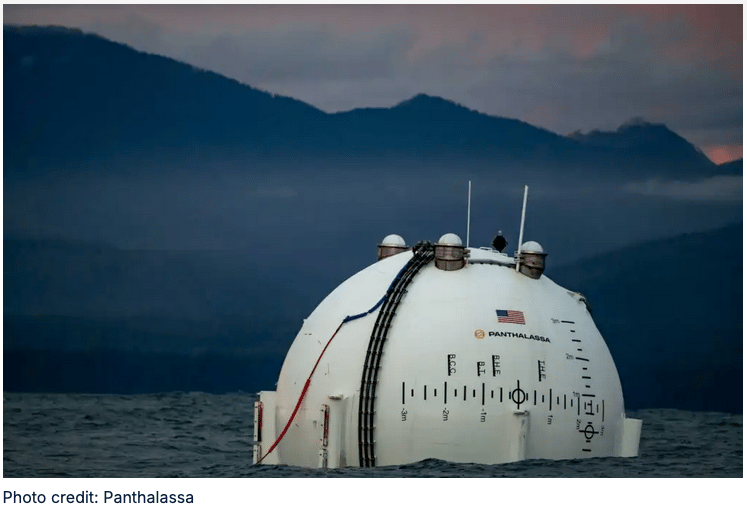
That backdrop makes Panthalassa’s latest move stand out. The startup just raised $140 million in a Series B led by Peter Thiel, the Silicon Valley billionaire and PayPal co-founder. The size of the round is notable in a sector that has struggled to attract sustained capital—but even more striking is the framing: wave energy not as a standalone power source, but as infrastructure for the AI data center boom.
Panthalassa’s approach departs sharply from traditional offshore renewables. It builds floating “nodes” that convert wave motion into electricity while also hosting AI computing hardware directly at sea. Designed to operate far offshore, the systems run on wave power, are cooled by seawater, and transmit data via satellite. The concept is meant to sidestep one of wave energy’s biggest historical barriers—costly undersea transmission cables—by moving computation to the energy source instead of sending electricity back to shore.
|
|
|
 |
|
|
|
The company’s name is a nod to “Panthalassa,” the ancient superocean that surrounded Earth’s supercontinent Pangaea, signaling its ambition to treat the ocean as a unified infrastructure layer for energy and computing. Each node can generate roughly one megawatt of power, supporting AI workloads while avoiding grid interconnection delays that increasingly constrain land-based data center expansion.
The pitch rides the wave of surging AI electricity demand, with advocates arguing that co-locating compute and generation could unlock stranded marine energy resources. But skepticism remains over whether the system’s technical complexity—wave capture, offshore engineering, autonomous navigation, and maintenance—can be made cost-effective at scale.
Still, the $140 million raise suggests wave energy is getting a second look, now reframed less as a grid substitute and more as a potential backbone for offshore computing.
|
|
|
|
|
|
Thanks for diving into the Developer Dispatch with us.
|
|
|
|
|
|
|
|
|
|
Building American power requires a powerful team. |
|
|
|
|
|
|
|
|