|
Was this email forwarded to you? Sign up here. |
 |
|
Good morning and happy Friday,
This week saw candidates endorsed by President Trump prevail in primaries in Oklahoma and South Carolina; the pro-solar super PAC Invest in Tomorrow continues to intervene in Republican primaries and is certainly getting noticed. In Alaska, Dan Sullivan is joining Dan Sullivan on the ballot in the state’s competitive Senate race.
The U.S. and Canada are in an escalating trade war; the U.S. administration placed 50% tariffs on roughly $20 billion worth of Canadian imports, and Canada promptly announced retaliatory tariffs of 15%, 25%, and 50% on nearly $20 billion worth of U.S. goods, set to take effect on September 8.
Ontario’s Premier Doug Ford has said “everything is on the table” and threatened to cut power and critical mineral exports to the U.S.; on Thursday, President Trump changed Lake Ontario’s name to Lake America.
Speaking of imports and energy, on Wednesday President Trump issued an executive order that declares a national emergency and restricts the purchase and installation of foreign-made grid equipment if it poses a risk to electricity supply or grid security. It’s too early to tell what the impacts will be for developers, but it’s another federal policy initiative we’ll need to keep an eye on.
And, the latest report from BNEF offers positive if mixed news; while global investment in renewable energy plateaued in the first half of 2026, investment in co-located solar and storage hit a record; that may change as the U.S. war with Iran spurs Europe and Asia to boost use of renewables.
Read on for more.
|
 |
A Flipped Forecast
Not so long ago, pundits projected that U.S. renewables were rising and natural gas was in decline. Fast forward to today, and the administration’s energy policies combined with the data center boom are reshaping the U.S. power-sector outlook, with new analyses pointing to substantially less renewable development, billions in lost investment, higher electricity costs and a major surge in proposed natural gas capacity. The scale of that shift—and how much of the gas pipeline ultimately gets built—remains uncertain. Here’s a big picture overview:
-
A new NRDC analysis estimates the loss of clean energy tax credits and other policy changes mean the U.S. stands to miss out on 390–540 GW of new wind, solar and storage capacity over the next decade.
-
By 2035, NRDC projects significant economic and public-health consequences as a result: up to $700 billion in lost power-sector investment (including $5-15 billion in additional fossil fuel spending), electricity rates that cost up to $30 billion more annually, and air pollution that increases health-care spending by up to $1.7 billion and contributes to ~70,000 additional premature deaths per year.
-
Meanwhile, Global Energy Monitor had identified 189 GW of gas capacity in announced, pre-construction or construction phases, nearly double its estimate from six months earlier. Much of the growth is tied to data centers, particularly in Texas, although GEM notes that many projects remain uncertain and may never be built.
-
Note that NRDC’s 9 GW of additional gas and GEM’s 189 GW pipeline aren’t contradictory. NRDC’s 9 GW is a modeled estimate of how much new gas generation current U.S. policies would add relative to its baseline, whereas GEM’s 189 GW counts projects in various stages of development, including many that face turbine shortages, financing challenges and other hurdles.
⚡️ The Takeaway
Power crunch, clean solutions. For clean energy developers, the near-term outlook is challenging, but the market need remains. Rising electricity demand, combined with uncertainty around how much new gas can actually come online, will likely leave significant room for renewables, storage and other flexible resources. The policy environment may be less favorable, but the underlying demand for new, reliable power continues to grow. |
 |
Manufactured in Ohio
Ohio’s renewable energy debate is highlighting a growing problem for regulators across the country: fake public input designed to distort the record and make it harder to distinguish genuine community sentiment from organized influence. Earlier this year, the Ohio Power Siting Board denied the 94 MW Crossroads Solar Grazing Center a permit despite evidence that dozens of opposing comments appeared fabricated. Canary Media takes a closer look at the situation, and what can be done to curb this trend:
-
In the Crossroads case, regulators confirmed they weighed the volume of opposition when deciding whether the project served the public interest; the OPSB cited “consistent and substantial opposition” but did not refer the comments to the Ohio attorney general for investigation.
-
Ohio encountered a similar issue in 2023, when nearly 150 people disputed pro-fracking comments submitted to the state’s Oil and Gas Land Management Commission. An attorney general investigation found that a subcontractor likely misled people into allowing their information to be used but filed no civil or criminal charges.
-
Last year Ohio revised its administrative code to strengthen rules against deceptive comment-gathering practices, but no enforcement action has been taken. Other states are being more aggressive: In New York, the attorney general secured a $615,000 settlement from companies that submitted millions of fake comments using consumers’ identities during the FCC’s net-neutrality proceeding.
⚡️ The Takeaway
Rigging the record. For clean energy developers, the episode underscores the importance of trustworthy public participation in siting decisions. Potential safeguards for the comment process include CAPTCHA-style verification, metadata analysis, confirmation emails, and investigations when fraudulent submissions are suspected. Notably, false input has also surfaced in relation to elections. Earlier this month Median Strategies admitted to releasing fake poll data “created as a short-term social experiment examining how purported polling information could enter and spread through the political information ecosystem without independent verification."
|
 |
|
|
 |
-
CT: Harwinton Town Zoning Commission holds informal discussion to draft BESS and solar moratoriums
-
IA: Floyd County Planning and Zoning Commission holds BESS ordinance amendment workshop with presenters from Mid-American Energy and Alliant Energy
-
IA: Ringgold County Board of Supervisors discusses Ringgold Wind, LLC’s application for temporary meteorological towers, and tax laws for electricity generation from wind energy
-
IL: Effingham Special Plan Commission holds public hearing on Heartville Solar 4 and 5, LLC’s SUP request
-
IL: Mackinaw Village Board of Trustees discusses resolution regarding wind and commercial solar energy facilities
-
IL: Madison County Zoning Board of Appeals discusses Grandview Wittman 2, LLC’s SUP request to develop a commercial solar energy facility
-
IL: McHenry County Zoning Board of Appeals considers Pivot Energy IL 78, LLC’s CUP request for 3-MW commercial solar energy facility
-
IL: Mundelein Village Board discusses motion to repeal and replace ordinance pertaining to text amendments to the Zoning Ordinance regarding BESS
-
IL: Pike County Board considers approval of Griggsville Solar East, LLC, and Griggsville Solar West, LLC
-
IL: Will County homeowners sue to block massive solar farm
-
KS: El Dorado Special City Commission considers resolution authorizing and providing for a Special Election to submit ordinance prohibiting the installation and operation of Tier 2 and Tier 3 BESS
-
LA: Washington Parish Council considers resolution placing a moratorium on approval and permitting of solar panel farms, commercial solar power plants, BESS, and similar energy generation and storage facilities
-
MA: Leominster Zoning Board of Appeals discusses Bluesky Utility LLC’s Administrative Appeal regarding the determination that the proposed BESS construction is prohibited under the city’s Zoning Ordinance
-
MA: Pittsfield City Council discusses communication from the Community Development Board on a petition for the proposed BESS Zoning Amendment
-
MI: Northfield Township Board of Trustees discusses zoning text amendments related to BESS
-
MN: Sauk Rapids City Council considers approving letter opposing Mayhew Lake Battery Storage Facility
-
NM: Quay County Board of Commissioners discusses BESS and wind energy conversion systems
-
NY: Geddes Codes, Planning and Zoning Committee discusses zoning regulations for future battery storage implementation
-
NY: Orangetown Town Board to hold public hearing on proposed law to establish temporary BESS moratorium
-
NY: Saratoga County Planning Board discusses proposed 12-month moratorium on BESS
-
NY: Wayne County Planning Board discusses Norbut Solar Farms, LLC’s proposal to construct 5-MW solar farm
-
PA: Longswamp Township Board of Supervisors holds public hearing on Zoning Ordinance amendment regarding solar energy systems
-
TX: Zapata County Commissioners Court discusses report on planned wind energy projects
-
WA: Northbend City Council discusses BESS moratorium and study update
|
 |
Holy Endorsement
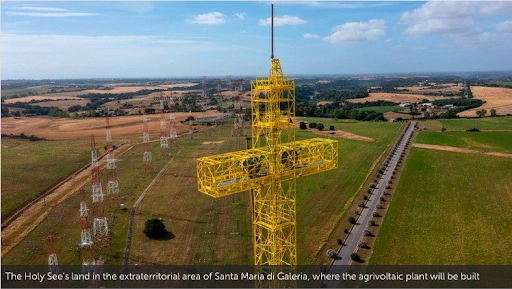
The Vatican may be the world’s smallest country, but it’s going 100% solar—the first nation to do so—in a big way, with plans to build a $117 million agrivoltaic facility in Italy that could make the Holy See energy self-sufficient within two years. Talk about a higher calling for solar.
The 80-90 MW project will be built at the Vatican-owned Santa Maria di Galeria estate outside Rome, where Vatican Radio has operated transmission facilities since the 1950s. Solar panels will cover roughly 200 hectares, with crops growing underneath. The panels will thus not only generate electricity, they’ll also shade the crops, reducing evaporation and helping protect them from extreme weather. |
 |
|
Construction is expected to take 18-24 months, including permitting and administrative work, with contracts going to tender in the next several weeks. The project could also supply power to Vatican-linked facilities, including Rome’s Bambino Gesù hospital. Any excess electricity would be supplied to Italy.
The initiative was a priority of the late Pope Francis and has been endorsed by Pope Leo XIV. Under a bilateral agreement, the project will also receive exemptions from Italian taxes and public charges, although Italy says it will not create additional public-finance burdens.
Agrivoltaics are lauded for their potential to maximize the productivity of the land that hosts them. By putting solar and farming in communion, the Vatican is blessing agrivoltaics with a bright future.
|
|
Thanks for diving into the Developer Dispatch with us.
|
|
|
|
|
|
Building American power requires a powerful team. |
 |
|
|
|
|
|
|