|
|
 |
|
|
|
Good morning and happy Friday,
U.S. drivers have seen some welcome relief at the pump recently, but a return to pre-war prices is likely months away, say experts. Meanwhile, oil industry execs are warning that inventories are dangerously low and “hitting tank bottom,” a situation that’s expected to cause prices to soar even higher soon.
Against this backdrop, ACP released its Clean Power Quarterly Market Report for Q1 2026, which finds that the U.S. now has 370 GW of clean power capacity, 6.4 GW of which was deployed in the first quarter of this year. However, that was matched by another 6.4 GW of clean power capacity that was expected to come online during Q1 but was delayed, adding to the 53 GW backlog of delayed projects.
Utility-scale solar and storage capacity additions weighed in at 3.625 GW and 2.382 GW respectively, compared to 415 MW of wind; as a result, utility-scale solar now exceeds wind as the largest source of clean power generation capacity in the country.
And, E2’s latest Clean Economy Works analysis finds that developers announced more than 50 new utility-scale generation and storage projects totaling over 12 GW and $18 billion in investment during the first quarter of 2026, but project losses are mounting.
Read on for more.
|
|
|
 |
|
|
The Empire Strikes Back
A group of clean energy donors is escalating its political spending, pushing the industry beyond lobbying into a higher level of direct electoral engagement to defend wind and solar interests. The Invest in Tomorrow Coalition (ITC), a group of renewable energy executives and investors led by CleanChoice Energy CEO Tom Mattzie, says it has already spent millions targeting anti-renewables lawmakers and has at least $15 million pledged for future campaign activity ahead of the midterms, signaling a more assertive political strategy for the sector. Here are some key deets:
-
Funding for the effort includes major contributions from clean energy investors and executives. The coalition argues that matching the political tactics of other major energy sectors is necessary to secure long-term policy stability for renewables.
-
The coalition spent about $1.7 million in a Texas Republican primary targeting Rep. Chip Roy, a leading opponent of wind and solar incentives. Rather than focusing on clean energy messaging, the ads emphasized Roy’s political positioning within the GOP and his alignment with President Trump. The spending helped elevate challenger Mayes Middleton, who ultimately defeated Roy.
-
The PAC is now weighing involvement in additional races, including against Reps. Andy Biggs of Arizona, Ralph Norman of South Carolina, and Nancy Mace of South Carolina, all of whom oppose clean energy incentives and are running for governor in their states.
-
At the same time, it has backed selected Republicans such as Iowa Rep. Mariannette Miller-Meeks, spending at least $125,000 in support of her reelection. This mix of backing allies and opposing critics reflects the group’s explicit goal of shaping a pro-clean-energy majority regardless of party.
⚡️ The Takeaway
A sign of maturation. The Invest in Tomorrow Coalition reflects a more assertive and ideologically flexible phase of clean energy politics, using targeted spending to both punish opponents and reward allies across party lines. With millions in play and multiple GOP targets identified, ITC’s approach represents an effort to build the type of political power and influence wielded by more mature industries—something the clean energy industry has not previously done—instead of outsourcing much of its lobbying and advocacy work to environmental and climate NGOs. This marks a shift from persuasion to leverage, as clean energy players seek durable political influence in an increasingly polarized energy debate.
|
|
|
 |
|
|
Spudtacular Rumors
In what feels like one of the stranger stories we’ve covered in the Dispatch, a new wave of anti-solar claims centers on potatoes, with some lawmakers and industry representatives suggesting that farmland hosting solar projects is unsuitable for potato production. It seems half baked, but here’s what you need to know:
-
The debate mixes land-use concerns with unsupported food-safety fears, with the latter focusing on unfounded claims about “toxins leaching into the soil or metal and silica shards impacting crops.”
-
The allegations have spread from local hearings to social media, despite a lack of evidence that solar installations contaminate soil or make crops unmarketable.
-
PepsiCo, whose Frito-Lay division was repeatedly cited in the rumors, says it has issued no directive against sourcing potatoes from land that hosts—or once hosted—solar projects.
-
Meanwhile, emerging research suggests solar and potatoes may be more allies than adversaries. A recent Italian study found that solar arrays can help potato growth by cooling crops, reducing evaporation, and improving soil moisture conditions.
⚡️ The Takeaway
Taters gonna tate. The episode illustrates how opposition to renewable energy increasingly relies on narratives that spread faster than facts. Like persistent claims that offshore wind is harming whales, the potato story has gained traction online because it taps into broader concerns about agriculture, rural communities, and food security, but has not been adequately rebutted by the clean energy industry. As project opposition is increasingly being fought in the information space, unsupported claims that sound alarming but aren’t rooted in evidence will continue to spread, requiring proactive debunking by developers and stakeholders.
|
|
|
 |
|
|
|
|
|
|
 |
|
|
|
|
 |
|
|
Poppy Seeds That Pass the Test
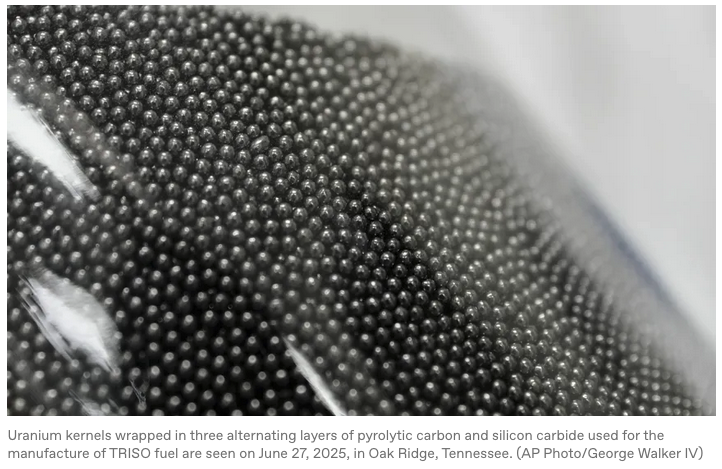
A tiny nuclear fuel particle could have an outsized impact on the future of advanced reactors. TRISO (tristructural isotropic particle fuel) consists of microscopic uranium kernels encased in multiple layers of ceramic and carbon-based materials. Each particle functions as its own miniature containment system, making it extraordinarily resistant to overheating and radioactive release—a feature that is increasingly shaping how regulators evaluate next-generation reactor designs.
That safety advantage is becoming a competitive advantage. New licensing pathways from the U.S. Nuclear Regulatory Commission, including Part 53 and the proposed Part 57, allow developers to make risk-based safety cases rather than navigate regulations originally designed for large light-water reactors. For reactor companies using TRISO, that could translate into faster permitting, lower costs, and fewer requirements for expensive infrastructure such as concrete containment domes and large emergency planning zones.
The NRC recently pointed to TRISO’s safety characteristics when approving construction permits for demonstration reactors being built by Kairos Power in Tennessee. Regulators concluded that the combination of TRISO fuel and molten-salt cooling created a form of “functional containment,” reducing the likelihood of a significant radiation release.
|
|
|
 |
|
|
|
The catch is cost. TRISO remains significantly more expensive than conventional nuclear fuel, largely because production volumes are still low. Manufacturers such as BWXT are betting that dedicated, large-scale facilities can change that equation, with plans to slash fuel costs through higher-volume production.
Demand could soon follow. As advanced reactor developers look for technologies that align with the NRC’s new regulatory framework, TRISO is emerging as a favored option. The fuel particles are about the size of poppy seeds—queue the famous Seinfeld episode in which Elaine fails a drug test after eating a poppy-seed muffin. We’ll be watching to see if regulators come to view these tiny specks as a primary safety system.
|
|
|
|
|
|
Thanks for diving into the Developer Dispatch with us.
|
|
|
|
|
|
|
|
|
|
Building American power requires a powerful team. |
|
|
|
|
|
|
|
|