|
|
 |
|
|
|
Good morning and happy Friday,
This week started with much of the country reeling from the onslaught of Winter Storm Fern, which sent power prices skyrocketing and knocked out power for more than 1 million customers – and the East Coast is facing round two as Winter Storm Giana is poised to hit the region this weekend.
Offshore wind energy racked up a few more wins this week: the Vineyard Wind project was allowed to resume construction, and in Europe, ten countries met in Germany to announce plans for the “world’s largest energy hub,” a “massive offshore buildout” that will install 100 GW of turbines in the North Sea by 2050.
Meanwhile, President Trump is scheduled to visit wind-friendly Iowa next Tuesday, where his anti-wind rhetoric could be a tough sell. And Heatmap reports that the Show Me State could soon become the “Show Me the Door State,” at least as far as solar is concerned.
Read on for more.
|
|
|
 |
|
|
Planted in Reality
The national debate over whether large-scale solar power is “overrunning” farmland has become especially heated in North Carolina, a state that is both a solar leader and a major agricultural producer. Critics – including the president, some state lawmakers, and farming groups – argue that solar threatens rural landscapes and food production. A new analysis from the North Carolina Sustainable Energy Association, however, finds that these fears are largely unsupported by data. Here are some key points:
-
Solar isn’t taking over farmland statewide. Utility-scale solar occupies less than one-third of 1% of North Carolina’s nearly 11 million agricultural acres, and this share has remained consistently small over multiple studies.
-
Solar isn’t dominating rural landscapes. It’s worth noting that solar installations are often concentrated near roads and power infrastructure, making them more visible and fueling perceptions of loss. While solar does occupy up to around 1% of the agricultural land in a few counties, it’s nowhere near dominating farmland statewide.
-
Rural communities aren’t losing productive land and income. While most large solar projects are sited on agricultural land, counties earn far more in property tax revenue from farmland with solar than from farmland without it. Farmers leasing land for solar earn roughly $750–$1,400 per acre annually, providing stable income.
-
Solar isn’t undermining the future of farming. As agrivoltaics gain popularity, solar projects are intentionally designed to allow crops, grazing, or pollinator habitats beneath panels, offering a way to pair energy production with continued agricultural use.
⚡️ The Takeaway
Perception is 9/10 of reality. Facts are great, but may not be the sole solution when facing distrust from “the state’s powerful $111 billion agricultural industry...distrust likely exacerbated by decades of bitter battle with environmental advocates – some of the same groups promoting clean energy – over pollution from hog and poultry factory farms.” These challenges are real, but the evidence suggests solar can coexist with agriculture – and even help sustain rural communities economically. |
|
|
 |
|
|
A Record-Breaking Year
BloombergNEF released its annual Energy Transition Investment Trends report this week. The headline is that global investment in the energy transition reached a record $2.3 trillion in 2025, up 8% year over year, and underscoring the sector’s resilience amid geopolitical tension and policy uncertainty. While encouraging, the pace of growth has slowed significantly compared to previous years, raising concerns about whether capital is scaling fast enough to meet climate targets. Here are some key facts and figures:
-
Most of the funds went toward electrified transport, which was the largest investment category at $893 billion (+21%), followed by renewable energy at $690 billion (−9.5%) and power grids at $483 billion. The decline for renewables was largely due to regulatory changes in China that introduced uncertainty.
-
Investment in clean energy supply totaled $1.293 trillion, surpassing investment in fossil fuel supply ($1.191 trillion) for the second year in a row. Fossil fuel investment fell $9 billion, driven by reduced upstream oil, gas, and fossil power spending.
-
Investment in the US increased 3.5% to $378 billion – but this was primarily from “investments in the electricity grid and electrified transportation, which was enough to offset a small decrease in spending on renewable energy.”
-
The Asia Pacific region accounted for 47% of global investment, with China leading at $800 billion (−4%), and the EU growing 18% to $455 billion.
⚡️ The Takeaway
Tough terrain. For US-based clean energy developers, the results are mixed. Areas with momentum include grid infrastructure, storage, and data center-driven load growth, and the $378 billion invested suggests capital remains available even as federal support fluctuates. That said, while US developers benefit from lower equipment costs as a result of global oversupply, they face domestic constraints that are unrelated to manufacturing – interconnection queues, transmission shortages, permitting risk, and labor. The terrain may be challenging, but with investment and demand from data centers rising, developers that can overcome local bottlenecks are well-positioned to turn today’s constraints into a near-term competitive advantage.
|
|
|
 |
|
|
|
|
|
|
 |
|
|
|
|
 |
|
|
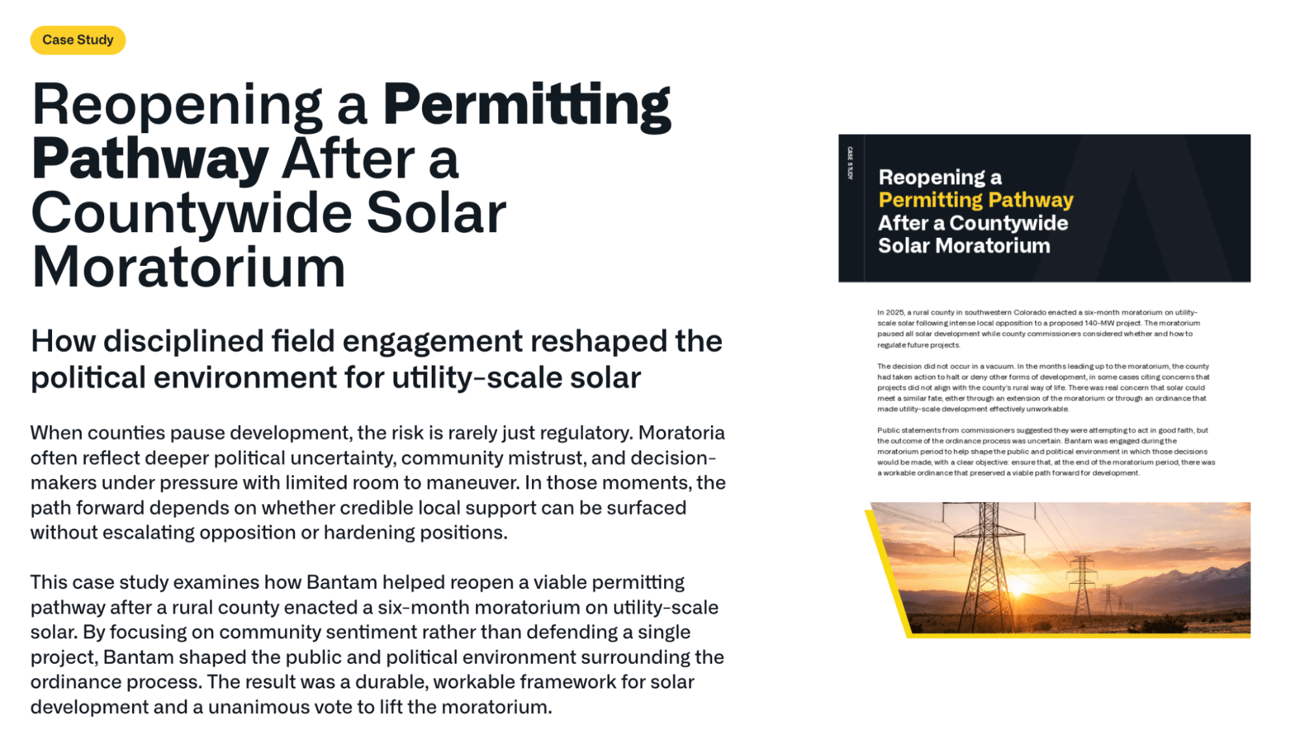
New Bantam Case Study: Reopening a Permitting Pathway
Our newest case study examines how a countywide moratorium on utility-scale solar was lifted—not through technical fixes or legal pressure, but through disciplined, listening-first community engagement that reshaped the local political environment.
When a rural county in southwestern Colorado paused all solar development, Bantam treated the six-month moratorium not as a procedural hurdle, but as a signal of deeper political risk. Mistrust among residents and uncertainty among decision-makers had narrowed the path forward well before any ordinance language was finalized
The study shows that permitting outcomes are often decided long before formal applications are filed. Rather than defending a single project, Bantam deliberately shifted the conversation to the broader question of whether solar development belonged in the county at all. By building visible, category-level support—and avoiding tactics that could mobilize opposition—we reduced polarization and expanded the space for elected officials to act.
|
|
|
 |
|
|
|
A listening-first canvassing program engaged nearly 5,000 residents, documented credible local support, and intentionally disengaged from hostile interactions to prevent escalation. The result was not louder advocacy, but clearer political cover: support that was local, durable, and difficult to dismiss
The outcome—a unanimous vote to lift the moratorium and adopt a workable solar ordinance—underscores a core lesson of the work: successful permitting is less about winning arguments than about reducing risk and preserving decision-makers’ ability to move forward.
If your project is facing a constrained or politically sensitive permitting environment, this case study shows how Bantam helps reopen pathways before they close.
Download the case study here.
|
|
|
|
|
|
Thanks for diving into the Developer Dispatch with us.
|
|
|
|
|
|
|
|
|
|
Building American power requires a powerful team. |
|
|
|
|
|
|
|
|


