|
|
 |
|
|
Good morning and happy Friday,
This week, the planet continued to sizzle, having recorded the hottest May on record and 12th consecutive months of record heat. Extreme heat has claimed dozens of human lives in India as well as in Mexico, which has
just elected a pro-renewables climate scientist president.
If climate chaos isn’t reason enough to get behind renewables, consider this: the fossil energy system is incredibly inefficient, wasting up to 2/3 of its primary energy, according to a new report released by RMI. Clean energy is much more efficient. “We have all this money that’s ready to flow,” said executives at Politico’s Energy Summit.
Indeed, some funds are already flowing: US clean energy investment reached a record quarterly high of $71 billion in Q1 2024, a huge jump from Q1 2023 ($51 billion) and all of 2018 ($78 billion), and global energy investment is set to exceed $3 trillion for the first time in 2024.
In an effort to ensure the energy transition stays on track, Evergreen Collaborative is putting its money where it matters and running ads that promote President Biden and the positive impacts of his clean energy policies in Michigan and Wisconsin. However, it is to be determined whether amplifying Biden + renewables in rural communities helps or hurts clean energy deployment.
Read on for more.
|
|
|
 |
|
|
Power Crunch
They say everything’s bigger in Texas, and that’s certainly true when it comes to energy – particularly in west Texas, which is home to the Permian Basin, the highest-producing oil field in the U.S. It’s also where four trends – curbing emissions from oil and gas, transmission constraints, booming renewables, and surging demand for power – are creating a potent mix. Here’s what’s happening:
Oil and gas producers are facing new EPA requirements to cut emissions by not venting or flaring excess natural gas and electrifying their operations to help further reduce emissions. One solution is to use the gas to generate electricity, and due to transmission constraints, the ideal power buyer is located nearby.
Almost all current industrial electricity demand in the Permian comes from oil and gas – but by 2030, 58% of demand is expected to come from crypto mining operations and data centers. Many tech companies have focused on Texas since 2021, when China banned crypto mining, sending businesses scrambling to find new places to locate their
facilities.
Of course, west Texas is also home to significant wind, solar and batteries, with a peak production capacity of nearly 12 GW. Since transmission constraints prevent much of this generation from getting to market, data customers – with their flexible load and ability to collocate – are again an ideal customer.
⚡️ The Takeaway
Big data = big business. As we reported last week, data center power use could double to 9% of US electricity by 2030, a situation that’s creating a climate dilemma for states that want to grow their economies whilst reducing emissions. Indiana has seen $14 billion in investment pledges for data centers this year alone, and similar demand growth is expected around the world – Norwegian developer Bulk Infrastructure has a $1 billion renewables-powered data center planned. Meanwhile, over at OpenAI, tech tycoon Sam Altman favors fusion power, and is investing to help that technology come to fruition.
|
|
|
 |
|
|
The Social Dynamics of Solar
The DOE announced a new program that will invest $9.5 million in four new projects that support social science research related to large-scale solar. The goal of the research is to “generate actionable insights that improve outcomes for host communities,” as well as help the solar industry site and permit facilities. Here’s what’s happening:
Community opposition is among the top three leading causes of project cancellations, according to LBNL, and it has ramped up in the last five years. Nevertheless, positive attitudes toward large-scale solar beat negative opinions by a 3-to1 margin in communities within three miles of a project.
The research projects supported by this funding will further understanding of these different social dynamics and help developers and communities find solutions that can enable ongoing growth of solar energy.
⚡️ The Takeaway
Sowing the seeds of success. The DOE funding will go to four organizations under the Solar Energy Evolution and Diffusion Studies 4 (SEEDS 4) program, and include Michigan State University, Princeton University, the University of Pennsylvania, and the Solar and Storage Industries Institute. Areas of focus will include ways to speed up the permitting process, community benefit agreements, how different siting practices shape community support, and innovative community engagement practices. We’re looking forward to seeing what they
find out!
|
|
|
 |
|
|
|
|
|
 |
|
|
|
 |
|
|
Back to the Future With V2G
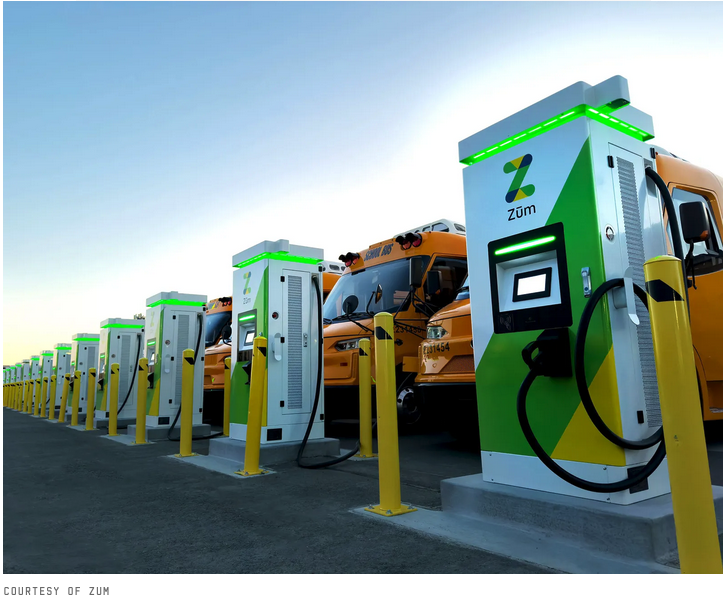
Big yellow school buses might not seem like icons of a clean energy future – but despite the fact that EVs have turned into something of a culture war issue, electric school buses are becoming more common across the country thanks to the EPA’s $5 billion Clean School Bus Program. That’s good news for school children, who are much more susceptible to air pollution.
In Oakland, they’ve taken things a step further with electric buses that – ahem – go both ways. Specifically, when not in use for transportation, the vehicles’ batteries act as energy storage and send power back to the grid: vehicle to grid, or V2G.
The Golden State is the perfect place for this technology. An abundance of solar power has already necessitated rapid growth in the energy storage sector, and on April 30, more than a fifth of California’s electricity came from batteries.
|
 |
|
|
More storage is needed, however, and for many reasons, buses are “ideal for V2G.” Most are done with their morning routes by 9:00 or 9:30 and can fast-charge on what’s effectively 100% solar power until their afternoon rounds. The buses typically drive short distances and use only a fraction of their large battery capacity, leaving a lot of stored electricity available to help meet rising demand for power in the late afternoon and early evening. Once they’re no longer needed as a source of electricity, they can switch back into charging mode and top up on grid power to be ready for the morning.
Passenger vehicles and other fleets can do this too, and in fact, it’s been calculated that we’d need less than a third of the world’s EV owners to opt into V2G programs to meet the demand for energy storage by the year 2030. While buses equipped with V2G cost considerably more than diesel buses, the revenue from energy sales offsets this and over the long run brings the cost to par with diesel buses – while also helping to stabilize the grid. Talk about making riding the bus cool again!
|
|
|
 |
|
|
Contact us to learn more about working with Bantam.
|
|
|
|
Contact Us
|
|
|
|
|
|
|
|
|
 |
|
|
|
|
|
Copyright © 2024 Bantam Communications, All rights reserved.
|
|
|
|
|

