|
Was this email forwarded to you? Sign up here. |
 |
|
Good morning and happy Friday,
It’s been a rough weather week in many parts of the U.S., and more mayhem is on the way. Hurricane Lala lashed Hawaii, with another storm predicted to hit this weekend; the Midwest was walloped with severe storms packing near-100 mph winds, and in Indiana NIPSCO reported its largest outage ever. The Northeast is next, and is bracing for storms that are expected to bring high winds and flooding.
Tuesday’s primaries brought some turbulence of the political kind … Democrats saw a northern light in Alaska, candidates backed by the president had mixed results in Wyoming, and in Florida, Republicans maintained their dominance, although Dems eked out some wins.
In financial news, U.S. government debt passed the $40 trillion mark for the first time, which is bad news for interest rates. On a more positive note, the latest threat of tariffs on Canada was averted at the eleventh hour; negotiators have until early Saturday morning to hammer out a new deal.
And, a new report from BNEF finds that MISO is now the nation’s largest grid in terms of capacity, thanks to a surge in solar generation.
Read on for more.
|
 |
Divergent Dynamics
Data centers are a hot topic these days, and they’re inextricably intertwined with energy. Exploring how states are approaching data centers offers some insights into how they’re thinking about siting and infrastructure policy. Here’s a closer look at how New York and Pennsylvania are handling things.
-
Last month, New York hit the brakes on data centers when Gov. Hochul issued an executive order pausing environmental permitting for new hyperscale data centers for up to a year while the state develops rules addressing grid impacts, ratepayer costs, water and land use, and community concerns.
-
Pennsylvania is taking a different tack: offering a permitting carrot. This week, Gov. Shapiro passed a new framework under which projects bigger than 25 MW can receive preferential state review if they commit to new power supplies, cover the costs they create across the electricity system, and meet escalating requirements for firm clean energy.
-
Across the country, the market is already moving toward “bring your own power.” It’s probably not a coincidence that earlier this month Invitium Energy (a joint venture between PPL and Blackstone) announced that it had secured 5 GW of gas turbines for data centers in Pennsylvania, an investment of roughly $15 billion; it has already secured sites in the state capable of supporting up to 14 GW of generation.
⚡️ The Takeaway
Policy that keeps pace. It’s clear that data center policy is becoming part of the power market—and, increasingly, part of the siting equation. It’s no longer a question of where there’s demand for new generation, but rather, where states are creating a workable path to serve that demand. Pennsylvania’s approach suggests that developers that can pair new load with new generation, storage or transmission solutions may find a faster route to market, while New York shows what can happen when concerns over electricity demand, water usage and community impacts outpace the policy framework. |
 |
Geothermal Heats Up
This week Canary Media provided some great coverage of next-generation geothermal, including a new Clean Air Task Force (CATF) report argues that the viability of the technology itself is no longer the primary barrier to deployment across the West—instead, the bigger challenge is creating the conditions that allow projects to attract capital and scale, a theme reinforced by recent headlines. Here’s what’s happening:
-
CATF’s review of 14 Western states identifies four policy levers for unlocking investment: better subsurface data, predictable permitting, early-stage financing, transmission, and continued R&D. Among them, transmission and permitting stand out: developers consistently cited grid access as a top obstacle, while increasing permitting capacity was the most common recommendation for where states should focus limited resources.
-
The report also points to demand creation as a powerful de-risking tool. California’s 1 GW clean-firm procurement requirement helped catalyze power purchase agreements for next-generation projects, including Fervo Energy’s 500 MW Cape Station. CATF argues that procurement targets and milestone-based financing can give investors enough certainty to bridge the gap between technology demonstration and infrastructure-scale capital.
-
The technology itself is showing that the opportunity is real. Sage Geosystems recently brought a 3 MW next-gen geothermal pilot online in Texas and reports that it has operated reliably for more than 120 days, with less than 10% water loss in multiple tests. The results will inform a planned Nevada project and, ultimately, a 150 MW project with Meta. Fervo, meanwhile, is preparing to bring Cape Station partially online this fall.
⚡️ The Takeaway
An alignment trifecta. The market is responding affirmatively in the form of capital investments. A June BLM geothermal auction in New Mexico generated $16.5 million, including a record $701-per-acre bid. Notably, analysis found that proximity to transmission was the strongest factor influencing acreage value—apparent confirmation of CATF’s argument that grid infrastructure is a key factor in geothermal deployment. We’ll be watching to see which states are able to achieve an alignment trifecta among policy, transmission and demand.
|
 |
|
|
 |
|
|
 |
Volcanic Ambitions
Geothermal energy is mostly about looking down. Endurance Energy is looking down and out to sea. The Seattle startup is betting that underwater volcanoes could unlock a huge new source of 24/7 clean power—bringing geothermal closer to coastal population centers while avoiding the increasingly crowded hunt for hot rocks on land.
There are plenty of engineering challenges to solve. Deep-ocean equipment must withstand extreme pressure, corrosion and mineral buildup, while repairs are likely to be expensive. Subsea transmission is another major consideration: Endurance is developing an optimization model to balance resource size, cable costs and proximity to coastal demand.
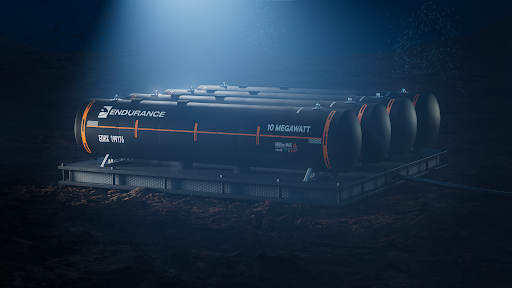
The company has already reached depths of about two miles and temperatures above 700°F. Next month, it plans to send “Adélie,” a 100-kilowatt geothermal generator named after a penguin, to an undersea volcano off Oregon. “Each unit is named for a sea creature, moving up the food chain as the generators grow—krill, silverfish, and eventually an orca pod.” |
 |
|
The system will drill roughly 200 feet into the seafloor to tap hydrothermal fluids that can reach 750°F. Those fluids heat a closed-loop refrigerant, which spins a turbine; naturally cold seawater then cools the refrigerant so the cycle can start again. Endurance’s staff joke that the whole thing mostly comes down to “heating, cooling and pumping.”
The concept builds on four earlier prototype deployments, including expeditions to the Juan de Fuca Ridge, Mariana Trough and waters near Tonga. Endurance ultimately aims to deploy much larger systems near coastal markets around the Pacific “Ring of Fire,” estimating that these resources could eventually support roughly 6 TW of generation.
Endurance has raised $63 million so far—including $54 million in June—and plans to follow Adélie with a megawatt-scale system for a commercial pilot in Tonga. For now, we’re awarding the company an honorary “Magma Cum Laude” for its achievements.
|
|
Thanks for diving into the Developer Dispatch with us.
|
|
|
|
|
|
Building American power requires a powerful team. |
 |
|
|
|
|
|
|