|
|
 |
|
|
|
Good morning and happy Friday,
It’s been an eventful week in the energy markets following US-Israeli attacks on Iran last weekend that triggered an escalating conflict. Oil and gas prices are surging, prompting White House Chief of Staff Susie Wiles to sound the alarm, and so far renewable energy is taking collateral damage in the U.S. – although the strikes are boosting China’s energy edge.
On Wednesday, President Trump met with AI leaders to discuss his ‘build your own power plant’ pledge; E&E News has summarized what you need to know about the deal, and warns that war and uncertainty could hamstring its implementation.
Are you or your colleagues heading to the ACP Siting & Permitting Conference in Aurora, CO at the end of the month? Bantam will be there—email us at hello@bantamcommunications.com to set up a meeting to talk about how we can support your projects’ success.
Read on for more.
|
|
|
 |
|
|
High-Voltage Acquisition
A massive deal for renewable energy leader AES Corporation underscores how the artificial intelligence boom is rapidly reshaping the energy industry. A consortium led by Global Infrastructure Partners and EQT plans to acquire the power producer in a deal valued at about $33.4 billion, taking the company private as electricity demand—driven largely by data centers—surges. Here are some fast facts:
-
The buyout, one of the largest recent deals in the utility sector, values AES at $10.7 billion in equity. Investors including the California Public Employees' Retirement System and the Qatar Investment Authority are backing the acquisition. Taking AES private is expected to give it the financial flexibility to fund major power investments without relying heavily on public markets.
-
The announcement came just days after AES signed a 20-year deal with Google to supply an 850-MW Texas data center using co-located solar and wind. The project is notable because it suggests renewables—paired with smart siting—can deliver new power as quickly as gas plants, which many tech companies have favored for reliability.
-
AES is attractive to investors because it spans two energy growth areas: regulated utilities with stable returns and independent power development supplying large tech companies directly. The company already has about 11.8 GW of clean-energy contracts with hyperscalers.
-
AI is driving a surge in electricity demand and investment across the sector. Analysts estimate U.S. data centers could require roughly 176 GW of power by 2035, helping push power-sector deals to nearly $142 billion in 2025 alone.
⚡️ The Takeaway
Amped for AI. For clean energy developers, the deal signals a major shift. Power companies that can build large projects quickly—especially renewables paired with storage—are becoming essential partners for AI infrastructure. As tech companies race to secure reliable power, developers with strong project pipelines and access to capital could find themselves at the center of the next wave of energy investment.
|
|
|
 |
|
|
Blown Off Course
The Trump administration’s campaign against offshore wind has had ripple effects across U.S. energy policy, including stalling a major bipartisan push for federal permitting reform. While fossil fuel groups have largely supported the administration’s energy agenda, some oil and gas lobbyists now worry the crackdown on renewables is jeopardizing their top legislative priority—streamlining approvals for large energy infrastructure projects. Here’s what’s happening:
-
Since returning to office, the administration has taken sweeping steps to halt offshore wind development, including withdrawing the Outer Continental Shelf from wind leasing, pausing permits, and issuing stop-work orders on projects already under construction. Courts have blocked several of these actions, but the government has continued appealing and escalating them.
-
The conflict has stalled negotiations over the SPEED Act, which would overhaul the National Environmental Policy Act. The proposal would shorten timelines for lawsuits, limit courts from halting projects outright, and prevent presidents from rescinding approved permits without a court order—changes strongly supported by oil and gas developers.
-
Talks collapsed after the administration halted offshore wind projects such as Empire Wind 1 and Revolution Wind despite completed federal reviews. Senate Democrats froze negotiations, arguing that permitting reform could not proceed while renewable projects were being targeted.
⚡️ The Takeaway
Viability amid vicissitudes. For clean energy developers, the episode underscores how political and regulatory risk can shape project viability as much as technology or market demand. If federal permits can be reversed or stalled after approval, financing large infrastructure—from offshore wind farms to solar plants—becomes more uncertain. However, the Interior Department’s renewed solar permitting could signal a path toward restoring negotiations and stabilizing the rules governing future clean energy projects.
|
|
|
 |
|
|
|
|
|
|
 |
|
|
|
|
 |
|
|
High Altitude Energy
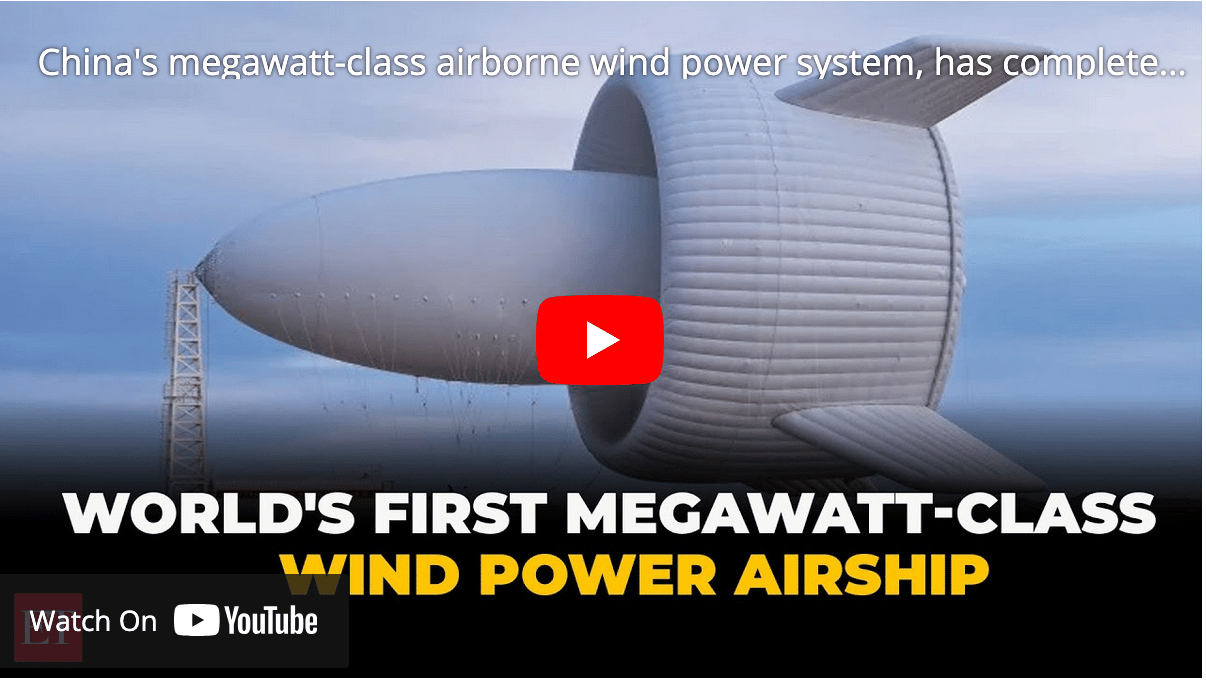
China has successfully tested the world’s first megawatt-class flying wind turbine, the S2000, a blimp-like airborne system developed by Linyi Yunchuan Energy Technology. Unlike conventional turbines mounted on towers or offshore platforms, the S2000 ascends to 6,560 feet (2,000 meters) to capture stronger, more stable high-altitude winds (check out the YouTube video).
During its test over Sichuan Province, it generated 385 kilowatt-hours of electricity—enough to power an average U.S. home for nearly two weeks. The 60-meter-long craft has a rated capacity of 3 megawatts, and electricity is transmitted to the ground through a tethering cable connected to the grid.
|
|
|
 |
|
|
|
What makes this development especially interesting is its access to high-altitude wind power density. Studies suggest wind energy potential can increase up to sixfold between 100 and 2,500 meters above ground, offering significantly greater efficiency than many land-based turbines. This could be transformative for countries with limited land for onshore wind or unsuitable seabeds for offshore projects.
Potential uses include supplying off-grid locations such as border outposts and complementing existing wind farms in a “three-dimensional” energy system. However, risks remain. The 2,000-meter tether poses aviation hazards and would face regulatory scrutiny in populated airspace. Maintenance could also be costly, as the turbine must be lowered for repairs. Reliability, grid stability, and long-term durability remain unproven.
If scalable and safe, airborne wind turbines could expand renewable capacity without large land or seabed footprints—offering a promising, though still experimental, pathway for clean energy expansion.
|
|
|
|
|
|
Thanks for diving into the Developer Dispatch with us.
|
|
|
|
|
|
|
|
|
|
Building American power requires a powerful team. |
|
|
|
|
|
|
|
|


