|
|
 |
|
|
|
Good morning and happy Friday,
As the war in Iran enters its ninth week, oil prices are back over $100 a barrel, and administration officials have sent mixed signals on their predictions for gas prices; meanwhile, the impact of high fuel costs is increasingly becoming a top electoral issue in the midterms, which are just six months away.
On Monday, President Trump invoked the Defense Production Act to juice fossil fuels as well as the production of essential grid equipment. On Wednesday many celebrated Earth Day, but on Tuesday U.S. Treasury Secretary Scott Bessent welcomed the impending expiration of the World Bank’s Climate Change Action Plan, calling its climate targets "distortionary" and "nonsensical."
Across the pond, on Thursday the European Commission presented its new “AccelerateEU” strategy, which proposes measures to tackle rising energy costs and cut reliance on imported fossil fuels.
And, two new analyses highlight the continued strong growth of renewables globally. Ember reports that in 2025, “renewable energy generation beat out coal…with record solar power expansion enabling clean power sources to meet all new electricity demand,” and the ISES finds that solar and wind “took over,” delivering “around six times more new capacity than all other power sources combined.”
Read on for more.
|
|
|
 |
|
|
Permitting Reboot
A federal court has delivered a significant reset for U.S. clean energy permitting, blocking a suite of Trump administration actions that had effectively stalled wind and solar development nationwide. In a preliminary injunction, U.S. District Judge Denise Casper found that the government’s actions were likely unlawful, offering developers a pathway to restart projects representing roughly 57 GW of at-risk capacity. Here’s an overview:
-
The court halted five key agency actions that had created a de facto permitting freeze, including the requirement that Interior Secretary Doug Burgum personally sign off on dozens of routine approvals and directives prioritizing “energy-dense” projects—a framework widely seen as favoring fossil fuels over renewables.
-
Judge Casper determined these policies were likely “arbitrary and capricious” and in violation of the Administrative Procedure Act, citing their abrupt departure from longstanding permitting processes and lack of sufficient justification, while also agreeing developers would face “irreparable harm” without intervention.
-
The blocked measures had far-reaching operational impacts: developers were cut off from critical environmental review tools, faced indefinite delays across federal agencies, and saw routine permitting processes grind to a halt—even for projects on private land that nevertheless required federal sign-off.
-
The stakes are substantial: about 57 GW of wind, solar, hybrid, and offshore wind capacity had been delayed or jeopardized, alongside roughly $905 million in sunk costs and billions more in potential tax credits, with ripple effects on grid reliability, project financing, and interconnection timelines.
-
For developers and supply chains, the ruling is an immediate—if partial—unlock. Trade groups say projects can now begin moving forward again, restoring some confidence in federal permitting as legal challenges continue to chip away at broader anti-renewables policies.
⚡️ The Takeaway
Limbo lifted? Still, the sector isn’t out of the woods. The decision is only a preliminary injunction, not a final ruling—and an appeal could quickly reintroduce uncertainty. While the order may begin to clear a massive project backlog and catalyze near-term permitting activity, developers should plan for continued legal volatility. The broader takeaway: courts are emerging as a critical backstop for project viability, but durable progress will depend on longer-term permitting reform and policy stability.
|
|
|
 |
|
|
State Roulette
A new multi-state study takes a systematic look at state-level wind and solar permitting, analyzing 460 projects across 19 states to assess approval rates, timelines, and where projects stall or are withdrawn. While most projects ultimately get approved, outcomes can vary dramatically by state—with Ohio emerging as a particularly volatile market. Here are some key deets:
-
The research finds that state-level permitting systems generally process projects successfully, with about 90% of applications approved and an average decision timeline of roughly one year. Even in higher-profile or more contentious jurisdictions, most projects still move through the pipeline rather than being rejected outright.
-
However, outcomes vary meaningfully by state. Ohio stands out with the highest number of rejections and withdrawals (although one brownfield solar project has threaded the needle). In contrast, states like Kentucky and Mississippi show very high approval rates.
-
The study also breaks permitting into stages and finds that the longest delays typically occur after applications are deemed complete, during agency review and decision-making. Differences in timelines across states are statistically significant, but are not driven by project type, size, or application year—pointing instead to institutional and procedural variation.
-
Withdrawals emerge as an important signal of friction: developers often pull projects when they anticipate likely denial or escalating costs, particularly in permitting environments where local opposition or regulatory uncertainty is high.
⚡️ The Takeaway
An unlevel playing field. For developers, the primary finding is that state permitting can be highly uneven in practice. While most projects in the study were ultimately approved, jurisdiction-specific dynamics—especially local authority, review structure, and political context—can materially affect risk and timing. Looking ahead, the key uncertainty is whether states with rising opposition or complex review processes converge toward more predictable timelines, or whether permitting divergence across states continues to widen as deployment scales.
|
|
|
 |
|
|
|
|
|
|
 |
|
|
|
|
 |
|
|
Perovskites: Ready for Primetime?
Loyal Dispatch readers may recall that way back in 2024 we first reported on perovskites, which “hold a place of honor in the pantheon of much-heralded clean energy breakthroughs that have yet to actually arrive” because they can be used to create super-thin coatings that harness the sun’s energy. Fast forward to 2026, and perovskite solar technology is starting to move from long-promised breakthrough to early commercial reality.
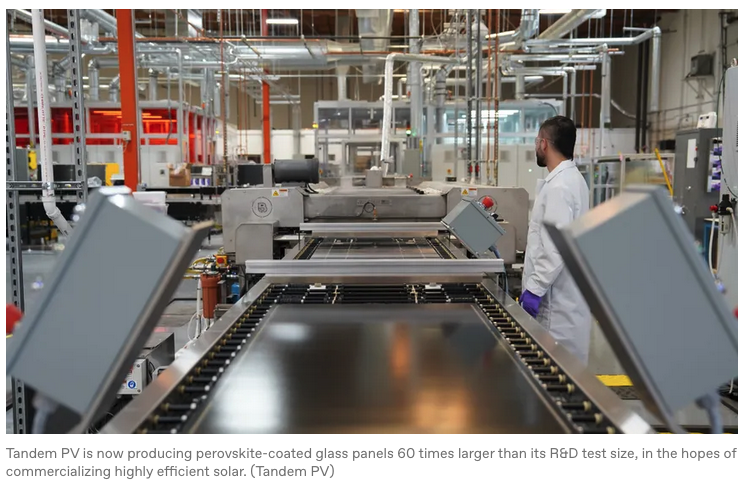
In California, Tandem PV has opened a 65,000-square-foot facility in Fremont producing “tandem” modules that layer a perovskite absorber on top of conventional silicon cells. The design boosts efficiency from roughly 22% in standard silicon panels to nearly 30% in internal testing—potentially increasing energy yield by about one-third within the same land footprint.
The factory will only produce about 40 MW of panels annually, but it’s a big deal because it represents a shift from lab R&D to automated, repeatable manufacturing. Tandem PV is now deploying test panels to developers in diverse climates to validate long-term performance and degradation rates under real operating conditions.
|
|
|
 |
|
|
|
At the same time, commercialization pathways are expanding. Caelux and Solx have partnered to target up to 3 GW of tandem module production by 2027, using a glass-based perovskite layer designed for easier integration into high-volume manufacturing. Their ~28% efficiency target prioritizes scalability and durability over absolute performance records.
For developers, the significance is clear: perovskites are no longer purely theoretical. The key question is whether tandem perovskite-silicon panels can deliver higher output without compromising durability, cost certainty, or bankability. We’ll be watching to see if tandem modules become a niche premium product or a mainstream shift in solar project design and procurement.
|
|
|
|
|
|
Thanks for diving into the Developer Dispatch with us.
|
|
|
|
|
|
|
|
|
|
Building American power requires a powerful team. |
|
|
|
|
|
|
|
|


