|
|
 |
|
|
|
Good morning and happy Friday,
Tomorrow will mark six weeks since the start of the war in Iran, although hostilities are currently on hold under a two-week ceasefire announced Wednesday. Oil prices dropped before creeping back up again, the stock market rebounded before turning downward again, and the world exhaled—a little.
The costs of the conflict continue to climb, but the WSJ reports that oil execs “raked in money” from the sale of $1.4 billion in stock sold in the first quarter. For his part, President Xi urged faster development of a new energy system to boost China’s energy security amid global shocks from the war.
In other news, NERC reports that it is ‘actively monitoring the grid’ after the U.S. Cybersecurity and Infrastructure Security Agency warned in an advisory Tuesday that hackers “affiliated” with Iran have been targeting equipment used in power grid operations.
The DOE unveiled a record $135 million investment in fusion as a “moonshot technology” to tackle key challenges and speed its path to commercial power. And, clean energy advocates prevailed in Arizona as a pro-renewable slate won control of the state’s biggest utility.
Read on for more.
|
|
|
 |
|
|
Bottlenecked Buildout
The finance technology firm Crux released a new whitepaper this week that puts hard numbers behind a frustration most clean energy developers already feel: federal permitting is no longer just a hurdle—it’s reshaping how, where, and whether projects get built at all. At a time when electricity demand is surging from data centers, electrification, and manufacturing, the report finds that regulatory friction is actively constraining deployment and distorting investment decisions across the market. Here are some key findings:
-
Developers are increasingly designing projects around what avoids federal oversight rather than what optimizes resource quality or the needs of the grid. More than 80% of respondents said they intentionally site projects to sidestep triggering federal reviews—redirecting capital away from potentially high-value locations, especially in regions with significant federal land exposure.
-
The real-world impact is already material. Survey participants alone reported approximately 11 GW of capacity affected in the past year, with 94% citing permitting as a contributor to delays or cancellations. These slowdowns—often stretching six months or more—include late-stage environmental reviews and interagency consultations that lock up capital and can stall otherwise viable projects.
-
Cost escalation is universal and significant. Every developer surveyed reported higher project costs tied to permitting delays, with the majority seeing total cost increases of 6-10%, and some exceeding 25%. These increases ultimately ripple downstream, affecting offtake pricing and ratepayer affordability.
⚡️ The Takeaway
Permitting gridlock. What developers want most isn’t necessarily faster approvals—it’s predictability. A clear majority (72%) said consistent, reliable timelines and outcomes would do more to unlock development than simply shortening the process, underscoring how uncertainty undermines financing and investment decisions. What’s clear is that federal permitting isn’t just slowing projects—it’s quietly reshaping the clean energy landscape, and increasing the cost of clean energy. While state and local rules ultimately shape permitting parameters on private land, without greater certainty and efficiency at the federal level, developers will continue to adapt in ways that may limit scale and leave critical capacity on the table just when it’s needed most.
|
|
|
 |
|
|
Decarbonization Dilemma
The AI boom is forcing utilities and state policymakers to rethink how fast the grid can decarbonize in the face of surging electricity demand. As hyperscale data center development drives load growth not seen in decades, states that once had a clear glidepath toward renewable targets are now grappling with a new reality: meeting this explosive demand may require more power, more quickly, than clean energy alone can currently deliver. Here are some points to ponder:
-
In Nevada, utilities are staring down an unprecedented load spike driven by data centers—potentially requiring three times the power used by Las Vegas—putting the state’s 50% renewable target by 2030 at risk and raising the likelihood of new fossil generation.
-
The Silver State isn’t an outlier in this regard: across the U.S., utilities are delaying coal retirements, adding gas capacity, and even scrapping net-zero goals as interconnection bottlenecks and slow renewable buildouts struggle to keep pace with hyperscale demand.
-
Data centers are increasingly shaping grid planning decisions, with some developers stepping up—like Switch, which built its own gigawatt-scale solar portfolio—but many others still relying on grid power that may tilt fossil-heavy in the near term.
-
States face a growing policy dilemma: how to capture the economic upside of AI growth while ensuring data center developers shoulder the cost—and responsibility—for clean energy procurement, rather than undermining renewable portfolio standards.
⚡️ The Takeaway
Guardrails for growth. To preserve clean energy progress, pro-renewable state policymakers will need to work with RTOs and utilities to reform and streamline interconnection processes to accelerate clean energy deployment, requiring data centers to procure dedicated clean or additionality-backed resources, and ensure that new load growth is explicitly aligned with renewable portfolio targets rather than diluting them. Without those guardrails, many utilities will default to gas and other fossil “bridges” to keep pace with explosive demand.
|
|
|
 |
|
|
-
Permitting Gauntlet: Renewable developers locked out of FWS online tool
-
Socket to Me: US power use to beat record highs in 2026 and 2027 as AI use surges, EIA says
-
Prominent Role: Low-voltage utility elections face surge of attention as electricity bills rise
-
Tariff Trouble: Trump adjusts metal tariffs, sets 15% rate for some electrical grid equipment
-
Double Standards: Administration’s offshore wind opposition was never really about the whales
-
Return to Stability: There’s hope for the offshore wind industry — yes, really
-
Raising *and* Lowering Prices: Batteries buying “free” California solar, driving up price
-
Trending Up: U.S. solar module prices face upward pressure as trade risks and FEOC rules dominate Q1 2026
-
Wiki-Solar: Large-scale solar surpasses 1 TWac worldwide
-
Setting a Precedent: Wisconsin city passes nation’s first anti-data center referendum and Wisconsin town revolts against a Trump-backed data center project
-
Running Into Reality: Data center boom poses early challenge for New Jersey’s affordability agenda
-
Greasing the Skids: Tech cash flows to Texas lawmakers debating data centers
-
It’s Complicated: How electricity prices fuel data center opposition
-
Policymaking Lag: How Virginia, Texas, and other states are starting to regulate data centers
-
Humor 😂: Our mom-and-pop data center
-
Workaround: Pennsylvania DEP seeks potential fast-track storage, generation projects
-
Report: Energy storage pricing beginning to ‘fracture’ by product type: report
-
“GFL to GFM:” ERCOT proposes $1,500/MW incentive for legacy Texas storage to adopt grid stability support
-
31 Recommendations: Arizona task force roadmap prioritizes virtual power plants and distributed solar to cut energy costs
-
Not So Seguro: 320 MW California battery project withdrawn and Developer pulls out of San Diego area battery project after local opposition
-
Promises Made: New Jersey becomes second state this year to lift its nuclear moratorium
-
Recycle, Reuse, Reduce ♻️: Commercial nuclear fuel recycling key to a sustainable supply
-
Making Waves: New report highlights 'steady progress' in ocean energy
-
Building Resilience: The global energy supply in a decade ‘is not a world we’re going to recognize’
-
90% Pay Cut: Why this TVA chief exec could be more challenging to replace
-
Report: Funding Alone Will Not Restore American Energy Leadership
-
Podcast: Frontier Forum: Why clean energy capital boomed in a volatile year
-
Opinion: A broken system is costing America trillions. I see it in Wyoming.
-
Opinion: Geothermal has the chance to get it right the first time around
|
|
|
 |
|
|
|
|
 |
|
|
Rooftop Revolution
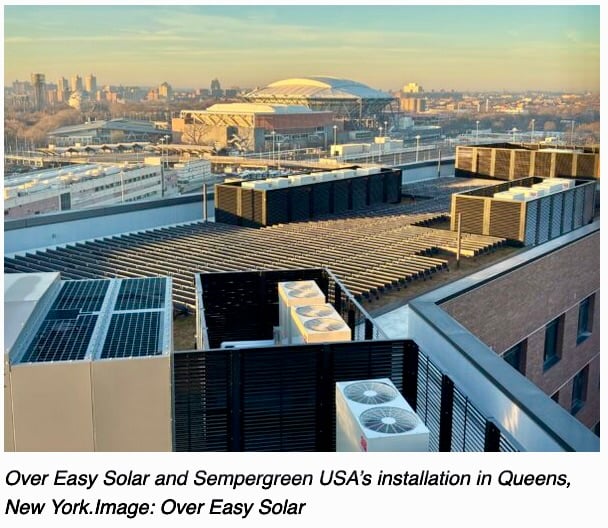
Solar panels just stood up—literally. Norwegian company Over Easy Solar has brought its vertical rooftop solar tech to the U.S. for the first time, installing a 100 kW system atop a green roof in Queens, New York. Instead of the usual tilted panels, these sleek, upright modules sit like rows of mini fences, soaking up sunlight from both sides thanks to bifacial tech.
Here’s the twist: they play nicely with plants. Traditional solar setups can shade and suffocate green roofs, but this vertical design lets sunlight and rain reach the vegetation below, keeping stormwater benefits and plant health intact. Even better, the system is super lightweight and doesn’t need roof-penetrating mounts—making it ideal for buildings that can’t support heavy loads.
|
|
|
 |
|
|
|
And their performance? Surprisingly competitive. The system is expected to generate around 120,000 kWh annually—right in line with conventional rooftop solar. It may even outperform during snowy months, when upright panels avoid snow buildup and capture reflected light.
The technology offers an opportunity for an exciting new synergy: solar + green roofs without compromise. Looking ahead, Over Easy Solar is rolling out tools to optimize these systems globally—and expanding into markets like Australia. The future of rooftops might not be flat anymore.
|
|
|
|
|
|
Thanks for diving into the Developer Dispatch with us.
|
|
|
|
|
|
|
|
|
|
Building American power requires a powerful team. |
|
|
|
|
|
|
|
|


