|
|
 |
|
|
|
Good morning and happy Friday,
It’s been a busy week on the permitting front – more on that in Must Read, below – and the latest energy storage report from ACP and WoodMac says the industry has been on a tear in 2025, with installations through Q3 growing 31% year-over-year and outstripping total installations in 2024.
Meanwhile, increased electricity demand from data centers continues to dominate the headlines, and at least three Democratic senators want to know more. In other news, Amazon Web Services announced this week that it had exposed a “years-long” cyber campaign by Russia’s GRU that targets energy and cloud infrastructure.
And, the administration’s anti-climate push has claimed another victim: the iconic National Center for Atmospheric Research in Boulder, Colorado, “one of the world’s leading Earth science research institutions,” will be dismantled.
On a brighter note, ten years on, the Paris Climate Accords are having an impact and have “set in motion a shift towards clean energy that no country can now ignore.” Even sea turtles are better off, thanks to solar-powered lights on fishing nets that help them evade entrapment.
This is our last Dispatch for 2025 – wishing you and yours a wonderful holiday season and a happy new year! We’ll be back on January 9th.
Read on for more.
|
|
|
 |
|
|
Full SPEED Ahead?
The SPEED Act – a sweeping permitting reform bill meant to accelerate energy and infrastructure projects – made for some drama in the House as an internal Republican revolt exposed deep divisions over renewable energy, especially offshore wind. The legislation significantly rewrites the National Environmental Policy Act (NEPA), but late-stage changes demanded by conservative lawmakers have reshaped who supports it, who opposes it, and what it could mean for clean energy development. At the end of a tumultuous week, the bill passed the House on Thursday – here’s what happened in the lead up:
-
On Monday, House leaders moved the bipartisan SPEED Act through the Rules Committee, setting it up for floor debate. The bill aims to shorten environmental reviews, limit lawsuits, and provide certainty for major projects ranging from energy to AI data centers.
-
On Monday evening, conservative Republicans and offshore wind opponents threatened to block the bill because they objected to language that would limit a president’s ability to revoke previously approved permits, which has been used against offshore wind projects this year.
-
As a result, on Tuesday, the bill’s rule vote stalled as several Republicans voted “no” or withheld support, temporarily putting passage at risk and highlighting fractures within the GOP between “all-of-the-above” energy advocates and anti-renewables hardliners.
-
Later that same day and following intense negotiations, House leaders agreed to tweak the bill to preserve the Trump administration’s ability to revisit offshore wind permits issued after Jan. 20. Most GOP holdouts flipped their votes, allowing the bill to advance.
-
However, the offshore wind tweak caused ACP to pull its support, arguing the revisions stripped away permitting certainty for renewables and undermined bipartisan compromise. CEO Jason Grumet said the change “fundamentally eviscerated the whole point of the legislation.”
⚡️ The Takeaway
Not separate, but not equal. The SPEED Act promises faster permitting, reduced litigation risk, and more predictable timelines – benefits strongly supported by business groups, fossil fuel interests, utilities, and Big Tech firms building energy-hungry data centers. However, these gains come at the cost of weakened environmental review and, after the revisions, diminished protections for renewable projects from political interference. If the SPEED Act were enacted in its current form, renewable energy could see mixed outcomes: faster permitting in theory, but continued political vulnerability in practice. Thus, while long-term NEPA reform could eventually help clean energy scale, the bill’s carve-outs for offshore wind signal that renewables may not receive equal treatment. |
|
|
 |
|
|
Good Ordinances Make Good Neighbors
In rural Pennsylvania, agricultural communities are grappling with how to balance renewable energy goals, private property rights, and preservation of farmland and rural character. A recent article explores these issues and finds that as interest in solar development accelerates, townships and state lawmakers are struggling to establish rules that communities view as fair, predictable, and protective. Here’s an overview of what’s happening:
-
Solar farms proposed on agricultural land have sparked strong emotional and practical concerns among residents. Objections center on altered viewsheds, perceived loss of rural beauty, potential safety risks, and fears of declining property values. For many residents, the sudden appearance of large installations feels imposed rather than negotiated, especially in areas without prior zoning or solar-specific regulations.
-
A core tension lies between protecting productive farmland and respecting landowners’ rights to lease or sell their property for solar use. Agricultural advocates worry about removing land from production for decades, while others emphasize that farmers need financial flexibility and alternative income streams. This divide has made consensus difficult within rural communities.
-
Townships with clear solar ordinances in place have been better equipped to manage conflicts. Common provisions include setbacks, limits on land coverage, emergency response coordination, and decommissioning requirements. Without such rules, communities feel vulnerable to rapid development with little local control.
-
Legislation that would create standardized decommissioning rules (SB 349) and restrict solar development on high-quality farmland (SB 336) has been proposed, but local leaders worry that one-size-fits-all laws “may not be the best vehicles for governing solar farm development” and could undermine tailored local solutions.
⚡️ The Takeaway
Hearts and minds. In summary, the article highlights the fact that winning support for and acceptance of solar projects in agricultural communities depends on early engagement, transparent planning, respect for local values, and ordinances that provide clarity while balancing the interests of all stakeholders. Solar development is more likely to succeed where communities feel they are shaping outcomes rather than reacting to them. For renewable energy supporters in the Keystone State, threading this needle is “key” to catching up in the clean energy race. Notably, “the amount of renewable energy brought online in Pennsylvania since 2015 would power fewer than 4% of the homes in the state. Only Washington and Alaska have been slower to develop renewable energy.”
|
|
|
 |
|
|
-
Messy Morass: FEOC rules go into effect in two weeks, but no guidance yet and Clean energy industry preps ahead of impending FEOC guidance
-
Hooray: For first time in months, BLM advances solar power project
-
Mooove Over, Sheep: RUTE SunTracker opening cattle grazing land to solar power
-
Optimistic: Energy secretary predicts that electricity prices will stop rising ‘very soon’
-
Fusion Frenzy: Clean, limitless energy exists. China is going big in the race to harness it.
-
More Fusion Frenzy: Trump Media to merge with TAE Technologies, a nuclear fusion firm, in a $6 billion deal
-
New Metrics: Beyond cost metrics: Recognizing the value of nuclear energy
-
That Sinking Feeling: Battery storage system prices continue to fall sharply, BNEF and Ember reports find
-
Dispatchable Solar: Analysis finds “anytime electricity” from solar available as battery costs plummet
-
Feeling the Squeeze: WoodMac: Top 10 solar panel manufacturers control 75% of global market
-
Kumbaya: Parties unite behind geothermal permitting bills
-
Steamboat Springs Adjacent: Why this Colorado coal town is digging geothermal
-
Another Record: Prices hit new highs in PJM electricity auction
-
Fluid Politics: Most Americans know little about data centers, poll finds and Views of AI and data centers
-
Supersize Me: Supersized data centers are coming. See how they will transform America.
-
Dirty Data: Virginia regulators weigh expanded use of data center’s polluting generators
-
Cutting Red Tape: Louisiana adopts ‘lightning speed’ process to power data centers
-
Rainbow: There’s a new color for hydrogen: Orange
-
Tricky: ERCOT’s market is transitioning toward storage and solar but ERCOT market redesign could leave battery developers in limbo; so, What to know about ERCOT’s new RTC+B program
-
Pivot: Ford’s ‘big strategic pivot’ into the ‘fiercely competitive’ battery storage market and Ford scraps EV plans, shifts to stationary energy storage
-
Not So Clean Energy: China’s clean energy investments abroad are a boon for climate, but human rights and the environment are a different story
-
Celebrating: Maryland calls for offshore wind proposals days after court victory
-
Eviction: N.J. port meant to be a wind hub is now at the center of a bitter legal feud
-
Time to Move On: Democratic think tank plans to ditch climate ‘purity’
-
Can’t REAP What You Don’t Sow: Wyoming ranchers hoping solar can lower costs say utilities and the state stand in their way
-
Another One Doesn’t Bite the Dust: Trump admin orders Washington state coal plant to stay running and House approves bill to keep coal plants on the grid
-
Stipulated Agreement: Georgia Power unveils surprise deal to expand power plants and Georgia Power agrees electric bill deal with regulators to enable 9.9 GW resource addition
-
Wait and See: FERC is poised to act on co-location of electricity and data centers
-
Lifeline: Watchdog to probe cancellation of $8 billion in energy grants
|
|
|
 |
|
|
|
|
 |
|
|
Worth Ruminating Over
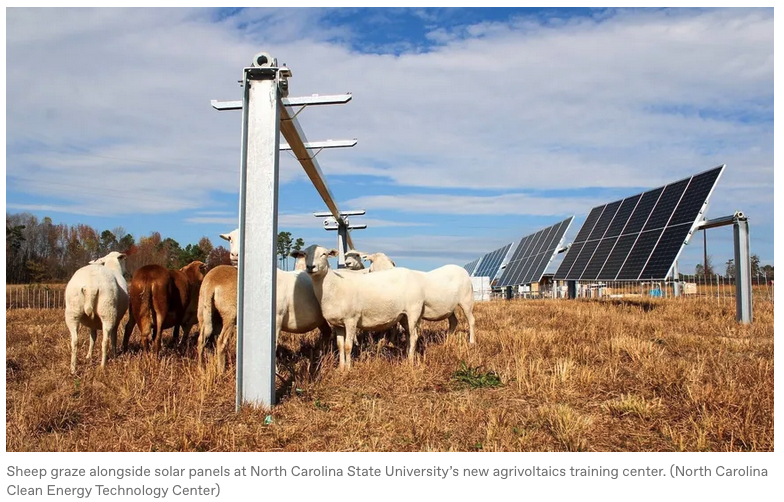
North Carolina State University has launched one of the Southeast’s first hands-on training sites dedicated to agrivoltaics. What’s new about this initiative is its integrated, practical approach: it brings together engineering students, solar professionals, and farmers at a single site to learn how sheep grazing can coexist with, and even enhance, large-scale solar installations.
Instead of treating solar and agriculture as competing land uses, the program is designed to teach how both can function together on working farmland. The training center focuses on using sheep to manage vegetation beneath ground-mounted solar panels.
Participants learn not only the technical aspects of solar systems but also the realities of livestock behavior, pasture management, and coordination between solar operators and farmers. This dual-perspective training helps address common knowledge gaps and reduces misunderstandings that often fuel resistance to solar projects in rural areas.
|
|
|
 |
|
|
|
A central player in the initiative is Nevados, which specializes in solar tracking systems designed to work on sloped terrain. Its equipment requires little to no land grading, which makes it especially suitable for agricultural settings. By allowing panels to be installed without disturbing topsoil, the technology supports continued grazing, protects soil health, and preserves natural drainage patterns.
In addition to donating equipment and helping to shape the program’s curriculum, Nevados’ participation benefits both the company and the broader industry. The site serves as an East Coast demonstration “sandbox” where developers can gain hands-on experience with newer mounting technology, reducing risk aversion. At the same time, farmers and students see how solar infrastructure can adapt to agricultural needs, reinforcing agrivoltaics as a practical, scalable model for rural energy development. Not baaad!
|
|
|
|
|
|
Thanks for diving into the Developer Dispatch with us.
|
|
|
|
|
|
|
|
|
|
Building American power requires a powerful team. |
|
|
|
|
|
|
|
|


