|
|
 |
|
|
|
Good morning and happy Friday,
This week, our neighbours in the Great White North voted to retain Mark Carney as Prime Minister, although as head of a minority party in Parliament.
On Monday, one of Europe’s most severe blackouts darkened most of the Iberian Peninsula. The cause is still being investigated, and U.S. Energy Secretary Chris Wright was quick to take a jab at solar. But while a lack of inertia may have contributed, “the nature and scale of the outage makes it unlikely that the volume of renewables was the cause.”
In other news, Ukraine signed a deal giving the U.S. access to critical minerals, which many say “represent a new energy crisis for America.” This comes on the heels of an executive order the president signed last week to boost deep-sea mining.
And, a pair of articles from Heatmap News look at rising opposition to renewables in previously friendly Iowa, and an upswell of opposition to data centers in Indiana.
Meanwhile, as outlined in our main stories below, ACP has been hard at work lobbying to preserve clean energy incentives in the IRA and boosting American-made BESS.
Read on for more.
|
|
|
 |
|
|
Voices from the Frontlines Hit the Hill
On Wednesday, ACP members were on Capitol Hill for a lobbying blitz designed to persuade lawmakers to preserve clean energy tax incentives created by the Inflation Reduction Act. Unlike previous “lobby days,” this time, it was “front-line workers” and not executives making the rounds. Here’s an overview:
-
In total, more than 160 people who work across the renewable energy supply chain, including folks employed as engineers, manufacturers, and solar panel installers, met with members of Congress to share their stories about “the job-creating impacts” of clean energy investments spurred by the IRA.
-
The lobby day was timed to coincide with legislators’ efforts to determine which portions of the IRA “survive, get tweaked, or die” in advance of a committee vote that could happen as early as next week.
- For its part, Americans for Prosperity – the ultra-conservative political advocacy group funded by the Koch brothers – has produced a 30-second ad explaining that eliminating “green energy scams” will help pay for President Trump’s tax cuts.
⚡️ The Takeaway
Lawmakers, are you listening? One thing seems clear – there are certainly a lot of jobs at stake. As clean energy workers fanned out across the Capitol, Climate Power released a report that finds the downturn in the industry has already resulted in “95 clean energy projects [being] threatened, delayed, or canceled, representing $71.24 billion in investment and 62,554 jobs,” noting that another 400,000 jobs could be at risk. Those are some big numbers, and hopefully they’ll get lawmakers to listen.
|
|
|
 |
|
|
Tariffs, Tensions, and BESS Ambitions
On Tuesday, ACP announced a historic commitment to invest $100 billion in building and buying American-made grid batteries, an action that is expected to transform the United States into a global battery manufacturing leader and fuel the creation of 350,000 jobs across the battery energy storage industry. Here are some key deets:
-
Bloomberg reports that at present, most batteries used in BESS are imported, “with 69% of lithium-ion imports coming from China.” However, “Chinese batteries now face a 155.9% tariff…potentially delaying some projects and forcing the cancellation of others.”
-
ACP says that more than 25 manufacturing facilities for grid-scale energy storage are already being built or expanded, with investments of $10-15 billion in progress. The $100 billion “represents both money committed for investment in new plants by 2030 as well as purchases of US-made batteries to install in the field.”
- On a related note, a new Clean Investment Monitor report from Rhodium Group looks at the state of clean energy supply chains as of Q1 2025 and finds that the IRA “helped spur $9.4 billion in new EV, battery and renewable manufacturing projects” in Q1, although a record $6.9 billion in investment was also lost due to uncertainty.
⚡️ The Takeaway
Tough to predict. The potential impact of tariffs on the U.S. energy storage industry has understandably attracted a lot of attention, and the question of whether they will ultimately help or hurt is “complicated,” according to experts. According to Utility Dive, “they remain bullish on the sector’s prospects,” and “some expect protectionist policies to boost U.S. battery manufacturing in the long run and – maybe – provide an opening for lithium-ion alternatives.”
|
|
|
 |
|
|
|
|
|
|
 |
|
|
|
|
 |
|
|
Steamy News From Down Under
We’ve devoted many Last Bytes to “exotic” new forms of energy storage, but this week we’ve got something a bit more pedestrian: hot blocks that produce steam.
That said, the blocks in question are pretty special. They’re Miscibility Gap Alloy (MGA) blocks, proprietary to MGA Thermal, and “specifically engineered for optimal latent heat storage.”
MGA’s Thermal Energy Storage System “offers a scalable means of firming variable renewable generation into a highly reliable and versatile supply of process heat, heat and power (cogeneration) or steam for electricity generation.”
Further, the company notes that “in the case of power station retrofits, [the system] can plug into existing electricity generation infrastructure making for a seamless transition and ultra-low carbon energy storage.”
|
|
|
 |
|
|
|
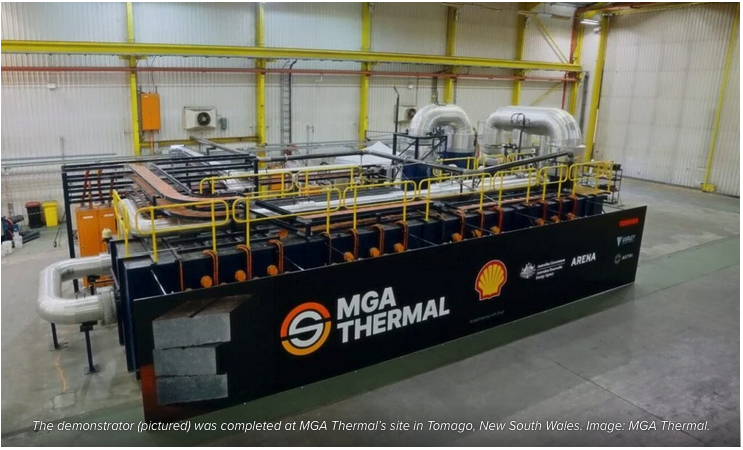
This week, MGA announced the successful operation of “the world’s first commercial Electro-Thermal Energy Storage (ETES) system.” Comprising approximately 3,700 of MGA’s blocks, the demonstration unit (pictured) is a compact 12m long x 3m wide x 4m tall and “stores 5 MWh of energy with a 500kW thermal dispatch power, providing continuous superheated steam for a full 24 hours – enough energy to power over 270 homes for the same duration.” Importantly, the systems boast an impressive 95% efficiency.
Sounds like something to get steamed up about.
|
|
|
|
|
 |
|
|
|
|
|
|
|
|
|
Building American power requires a powerful team. |
|
|
|
|
|
|
|
|


