|
Was this email forwarded to you? Sign up here. |
 |
|
Good morning and happy Friday,
The U.S.-Iran war is now in its seventh month, and this week tit-for-tat military strikes have intensified, ending a brief period of calm and driving fuel prices back up to near-record highs.
Last Friday President Trump announced “the biggest oil deal in world history,” one that will give the U.S. "majority control" of 65 billion barrels worth of oil reserves in Venezuela—but don’t expect that to impact prices at the pump anytime soon, since "A barrel counted as a reserve is not a barrel at a refinery, and in Venezuela the two are decades apart." Meanwhile, experts question how long the deal will last.
Axios had some interesting coverage of the data center debacle this week, noting that “Build American AI—an advocacy group tied to pro-AI super PAC Leading the Future—is spending big on the AI data center fight, with plans to pour millions of dollars into battleground states.”
And once again, it’s a mixed bag of headlines on the clean energy / climate front: SEIA’s Q2 report finds that the U.S. added 20 GWh of storage capacity, the biggest quarter on record; one big driver is demand for behind-the-meter batteries for data centers, which is expected to quintuple by 2030.
That’s great news, given that the IEA’s mid-year update says the world is using more electricity than ever—but the latest UN report says the planet is locked into a climate overshoot trajectory.
One more thing before we dive in: Bantam is hosting its first-ever Developer Dispatch Live on September 16, and this week's Last Byte has everything you need to know (and the link to register). Don't skip dessert.
Read on for more.
|
 |
Gridlock: Electric Boogaloo Edition
President Trump’s August 26 executive order restricting foreign-produced bulk-power equipment has introduced complex new hurdles for clean energy developers, compounding existing supply chain bottlenecks and overlapping with strict federal tax credit rules. Here’s a high-level overview of the state of play:
-
A summary from industry legal guru Keith Martin details that the EO bans the acquisition, importation, or installation of electrical equipment linked to 24 sanctioned countries, with a primary focus on China. The DOE has 120 days to establish implementing rules, leaving developers in a holding pattern as they evaluate potential risks to existing and planned infrastructure.
-
Utility Dive cites BNEF analysis that says the energy storage sector faces the most acute near-term risk, with deployment delays and project cancellations likely as developers scramble to find alternative suppliers or redesign projects.
-
PV Magazine cites Wood Mackenzie data that indicate the order will severely exacerbate an active 15% shortage for power transformers and an 8% shortage for substations, hitting large-scale data centers and renewable energy integrations particularly hard.
-
A Latitude Media piece published Aug. 28 notes that some energy storage developers are running the math to determine if trying to qualify for the ITC by purchasing domestic equipment is worth it, given all the hoop-jumping required; however, the article doesn’t appear to factor in the EO, so some points may be moot.
⚡️ The Takeaway
Supply shocked. As the market awaits the December 24 deadline for the DOE’s rulemaking—which will clarify vendor pre-qualification, licensing, and whether previously installed equipment must be ripped out or modified—legal experts advise developers to immediately map vulnerable assets, review supply contract risk allocations, and prepare for potential mandates to isolate or replace previously installed equipment. While long-term relief may arrive as domestic manufacturing capacity ramps up, developers currently face a difficult balancing act between federal security mandates, tax credit eligibility, and severe component scarcity. |
 |
High-Voltage Horizons
Expanding and modernizing the nation's high-voltage electrical pathways is essential to supporting record levels of clean energy. Recent analyses emphasize that strategic transmission buildouts, targeted line upgrades, and multi-region interties can unlock billions in customer savings and dramatically boost grid reliability. Here’s a closer look at some key points:
-
A new study by S&P Global’s CERA Consulting highlights that 13 high-value inter- and intraregional transmission projects across the Eastern Interconnection could generate up to $15.3 billion in net system value through 2050—including $6.7 billion in PJM—lower retail electricity rates, and reduce the need for costly local generation builds.
-
Research from Evolved Energy Research demonstrates that reconductoring existing transmission lines with high-capacity conductors in Texas could avoid $30 billion in greenfield transmission costs for a net savings of $20 billion through 2040.
-
The Texas study illustrates that upgrading existing power lines with advanced, high-capacity conductors can dramatically increase the availability of electricity at a fraction of the cost of building new lines from scratch—a financially efficient way to meet fast-growing demand.
-
Meanwhile, Grid United’s ambitious North Plains Connector project—a 420-mile high-voltage direct current link backed by $700 million in federal grants and bipartisan DOE support—illustrates how interregional projects can connect disparate time zones and enable grids to lean on one another during extreme weather events.
⚡️ The Takeaway
Lines of site. Updating transmission infrastructure has the potential to deliver huge benefits. Making that scenario a reality will ultimately depend on overcoming familiar challenges related to planning frameworks, cost-sharing allocations, and state and local approvals. Strengthening the reliability and resiliency of the nation’s power grids requires that developers and utilities earn their social license to operate—building lasting trust with local communities and landowners as they navigate complex regulatory frameworks and multi-year project pipelines. Federal permitting reform that expedites transmission deployment would help too.
|
 |
|
|
 |
-
CT: Harwinton Town Zoning Commission holds informal discussion to draft BESS and solar moratoriums
-
IA: Floyd County Planning and Zoning Commission holds BESS ordinance amendment workshop with presenters from Mid-American Energy and Alliant Energy
-
IA: Ringgold County Board of Supervisors discusses Ringgold Wind, LLC’s application for temporary meteorological towers, and tax laws for electricity generation from wind energy
-
IL: Effingham Special Plan Commission holds public hearing on Heartville Solar 4 and 5, LLC’s SUP request
-
IL: Mackinaw Village Board of Trustees discusses resolution regarding wind and commercial solar energy facilities
-
IL: Madison County Zoning Board of A
-
CO: Elbert County Community and Development Services holds public hearings on Shepherd Solar projects
-
CO: Grand County Board of County Commissioners discusses Variance Requests to moratorium a resolution for commercial solar system and BESS
-
GA: Douglas County Planning and Zoning Board discusses West Atlanta Energy Storage, LLC’s rezoning and SUP request to allow for BESS facility
-
IA: Worth County Board of Supervisors discusses and receives public comments on Worthwhile Solar Farm West Agreement
-
IL: DuPage County Development Committee considers amendments to Zoning Ordinance to be in compliance with Public Act regarding commercial wind and solar facilities, and energy storage systems
-
IL: Logan County Transportation Committee discusses status of Top Hat and Pike Creek Wind Farms
-
IL: Macoupin County Road and Bridge Committee discusses 2nd supplement to the Construction Engineering Services Agreement for Lotus Wind Farm
-
IL: McLean County Zoning Board of Appeals considers Blooming Grove Solar Energy Center, LLC’s special use application for commercial solar facility
-
IL: Will County Board Planning and Zoning Commission discusses Cosmos Solar 1, LLC & Cosmos Solar 2, LLC’s SUP request for commercial solar energy facility
-
IN: Van Buren Board of Trustees considers denial of special land use request by Stag Horn, LLC to install 200-MW BESS
-
MA: Carver Conservation Commission holds public hearing on Federal Pond Solar, LLC’s Notice of Intent to construct dual-use agriculture/solar array and ground-mounted solar arrays with BESS
-
MA: Truro Planning Board holds public hearing on NextGrid Pecan, LLC’s request for Commercial Site Plan Approval to allow for construction of 7.68-MW ground-mounted solar photovoltaic with associated BESS
-
MI: Grand Traverse County Board of Commissioners discusses correspondence from from Shipyard Solar, LLC regarding proposed solar and BESS facility
-
MI: MPSC approves siting settlement on Ingham County solar project, ensuring protections, benefits for impacted communities
-
MN: Redwood County Board of Commissioners discusses Albrecht Wind Energy’s CUP request
-
MO: Lincoln County Commission discusses proposed ordinance imposing 6-month moratorium on utility-scale BESS, and commercial or utility-scale solar energy facilities
-
MO: Smithville Board of Aldermen considers AYPA Power’s Rezoning, Plat Approval, and Conditional Use Permit request for BESS facility
-
NJ: Egg Harbor Township Environmental Commission reviews ordinance on BESS zoning and considers amending prohibited uses
-
NY: Amherst Traffic Safety Board discusses site plan and rezoning for proposed BESS
-
NY: Hamburg Planning Board holds public hearing on Hamburg II East ESS, LLC and Hamburg II West ESS, LCC’s request for Zoning Board Approval of Use Variance, Planning Board Approval for Change of Use, and Site Plan Approval for Tier 3 BESS
-
NY: Town of New Scotland Planning Board discusses AIP New York Battery 1 DevCo, LLC’s SUP request to operate a 4.5-MW BESS
-
NY: Washington County Board of Supervisors discusses local law prohibiting commercial BESS within the Town of Salem
-
NY: Wheatfield Town Board considers resolution enacting temporary moratorium on BESS
-
NY: White Plains Zoning Board of Appeals discusses New Leaf Energy’s application for 1-year extension of the Resolution granting use variance to install a BESS facility
-
UT: Sanpete County Planning Commission discusses ordinance on solar energy facilities
-
VA: Culpeper Planning Commission discusses Culpeper BESS’s CUP request
-
WA: Bonney Lake Community Development Committee discusses BESS facilities
|
 |
The Room Where It Happens
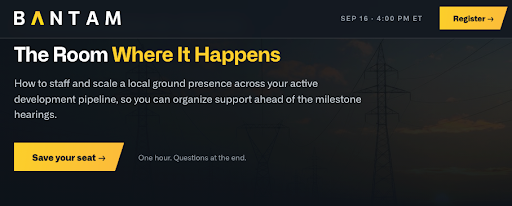
The Last Byte is usually where we point you toward something clever someone else built. This week, we're pointing you toward something we built, and we think you'll want a seat to the show.
On Wednesday, September 16, we're hosting the inaugural session of the Developer Dispatch Live, a new quarterly series that takes the premise of this newsletter and puts it in a room—albeit a virtual one—instead of an inbox. Every quarter, we'll dig into the people and politics that determine whether energy projects get built, and swap best practices with the developers, public affairs pros, and community engagement teams working these issues day in and day out.
Session One is called "The Room Where It Happens," and it's about exactly that: the hearing room, who shows up in it, and how to staff a local ground presence across your active pipeline so support is organized before the milestone hearings, not cobbled together the week of.
|
 |
|
In one hour, we'll cover why it now costs roughly four times more to find a project supporter through digital outreach than it did a few years ago (and what that changes about resource allocation), the two models of local presence and when to reach for each, and the three questions your team should be asking every single week. We’ll also explore a Midwest battery storage case study where the planning and zoning board recommended denying the project a permit, but the county commission approved it 7 to 2. We'll tell you what turned an apparent defeat into a win.
Bantam's Natasha Healey, Frank Rizzo, and Stu Adams will host the event, with plenty of time for your questions at the end. It's online, it's free, and if you can't make it live, registrants will receive a link to a recording of the session.
Wednesday, September 16, 4:00 to 5:00 pm Eastern. Save your seat here.
|
|
Thanks for diving into the Developer Dispatch with us.
|
|
|
|
|
|
Building American power requires a powerful team. |
 |
|
|
|
|
|
|