|
|
 |
|
|
|
Good morning and happy Friday,
Oil prices were back up to $100 a barrel on Thursday following attacks by Houthi rebels on Saudi Arabian tankers in the Red Sea; shipping traffic in the Strait of Hormuz has stalled out, and the renewed hostilities are pushing gas prices back up, casting “a persistent dark cloud” over the midterms for GOP candidates.
Meanwhile, many Americans are continuing to face poor air quality caused by smoke from Canadian wildfires, which could persist into August; over the weekend, President Trump told Prime Minister Carney that he had to take action to get the fires under control, although Canadians are also dealing with smoke from American wildfires.
Citing retaliation for the wildfire smoke as a driver, President Trump on Monday imposed new 50% tariffs on Canadian goods as he sought to “rebuild the tariff wall knocked down by the Supreme Court.”
In other news, back in 2024, the IEA declared that the world was officially entering the "Age of Electricity," and its latest update supports this, forecasting that in 2027 global consumption will reach 30,700 TWh, up from 28,600 TWh in 2025. It projects that in 2026, more electricity will be produced from renewable energy than from coal.
And the World Cup is now in the rearview mirror, but if you bet on the outcome of the final match, you certainly weren’t alone. The New York Times reports that it may have been the largest gambling event in history, with at least $5.69 billion wagered on prediction markets Polymarket and Kalshi.
Read on for more.
|
|
|
 |
|
|
States of Play
The Siting Solutions Project has just released its 2026 State of Siting report, which reviews 201 bills introduced across 40 states this year. Lawmakers introduced many bills aimed at slowing renewable development, but the outcomes were notably more favorable than in 2025: most restrictive proposals failed, while enacted legislation leaned decisively toward making it easier to build clean energy projects. For developers, this suggests defensive advocacy in hostile legislatures, combined with pragmatically calibrated reforms in more welcoming ones, was effective in 2026—with an assist from the economic and political pressure stemming from skyrocketing load growth. While the bottom line is encouraging, broader permitting reforms that address the proliferation of moratoria and de facto bans are still needed to accelerate deployment. Here are some high-level findings:
-
While restrictive bills still outnumbered permissive proposals, they rarely became law. Industry and advocacy efforts successfully defeated many of the most aggressive measures—including moratoria, expanded local veto authority, and other de facto bans. Of the 29 bills enacted, 16 supported cleaner, more predictable permitting pathways.
-
Several states advanced meaningful, if incremental, reforms. Virginia, Illinois, Oregon, and Washington led the way by streamlining permitting or creating clearer statewide standards, while Republican-led states including Oklahoma also adopted practical policies, such as establishing reasonable decommissioning requirements for solar and battery projects.
Battery storage stood out as a bright spot, with states generally focusing on modernizing safety and permitting frameworks rather than creating new barriers—an encouraging signal as storage becomes increasingly central to grid expansion.
-
The report reflects a growing recognition that meeting rising electricity demand requires adding generation faster, which was enough to keep the most aggressively hostile bills in states like Oklahoma and Missouri from advancing and provided tailwinds in states enacting pro-deployment reforms. But local opposition and misleading rhetoric remain significant hurdles to building a durable, bipartisan consensus moving forward.
⚡️ The Takeaway
🚦Green means go. As states race to meet rising electricity demand, renewable energy siting and permitting remain a major legislative battleground, and the Siting Solutions Project has launched a new interactive legislative tracker that allows developers to monitor bills, policy analysis, legislative status, as well as expected deployment impacts across every state. Looking ahead, 2027 is expected to bring another busy year for siting policy amid growing pressure from data center load growth and electricity affordability concerns: watch for defensive campaigns in Texas and Iowa and permissive reforms in Pennsylvania, Virginia, and Indiana.
|
|
|
 |
|
|
Texas: Fast, but Not Easy
As debates over renewable energy siting intensify and electricity demand continues to climb, Texas remains one of the country's most closely watched clean energy markets. Two new reports offer complementary perspectives on why the state continues to attract renewable investment: one examines how quickly projects move from development to operation, while the other explores how policymakers can preserve that momentum as siting debates evolve.
-
Resources for the Future reviewed 76 utility-scale wind and solar projects built between 2018 and 2025 found a median development timeline of roughly 3.5 years—about 40% faster than comparable projects on federal land. Local tax incentive approvals, often the closest proxy for permitting, averaged just 6.5 months for solar and 7.5 months for wind, substantially faster than many state permitting processes.
-
Speed, however, does not mean simplicity. Project timelines vary widely as developers secure land, negotiate local agreements, complete interconnection studies, and finalize offtake contracts. Much of this work occurs outside the public record, making it difficult to identify the biggest drivers of project delays or compare timelines across states.
-
The findings reinforce that Texas' decentralized approach can support rapid deployment, but success depends on a complex mix of local approvals, private agreements, and grid coordination rather than the absence of regulation. The RFF researchers also note that better project-level data would improve comparisons across states and help identify opportunities to streamline development.
⚡️ The Takeaway
The case for clarity. A second report from Environment Texas shifts the focus from speed to certainty. Noting that “In the absence of clear rules of the road, renewable energy opponents have used conservation concerns to justify sweeping legislative proposals that could halt or dramatically slow wind and solar development statewide,” it argues that the state would benefit from science-based statewide siting standards, risk-based permitting, and clearer environmental expectations that protect sensitive habitats while providing developers with more predictable approval pathways—without sacrificing the speed that has made it a renewable energy leader.
|
|
|
 |
|
|
|
|
|
|
 |
|
|
|
|
 |
|
|
The “Mother of All Co-location Projects”
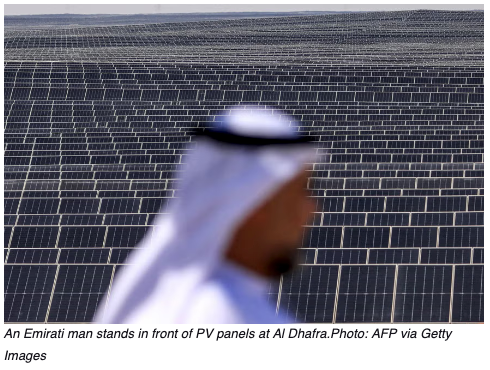
Last week, Masdar reached financial close on its landmark round-the-clock renewable energy project in Abu Dhabi, securing a $5.1 billion financing package from a consortium of 13 international and regional banks.
The $6.1 billion project combines 5.2 GW of solar with 19 GWh of battery storage to deliver 1 GW of continuous clean power, making it the world's first gigascale 24/7 renewable energy project. Construction began in late 2025, with commercial operations expected in 2027, and the financing marks a major vote of confidence in the commercial viability of utility-scale, dispatchable clean energy.
|
|
|
 |
|
|
|
The project arrives as electricity demand from AI, data centers, and advanced manufacturing is driving interest in firm, carbon-free power. Beyond its scale, the financing milestone signals that lenders increasingly view renewable-plus-storage projects as bankable infrastructure rather than experimental concepts.
The breadth of the lending syndicate also demonstrates confidence not only in the technology, but in the contractual structures, revenue models, and execution capabilities needed to support projects of this complexity.
Industry observers describe the development as the "mother of all co-location projects"—an unprecedented pairing of solar generation and battery storage that sets a new benchmark for 24/7 clean power. While analysts caution that few markets can immediately replicate a project of this size, they see it as an important proof point that continuous renewable generation can attract large-scale institutional capital.
|
|
|
|
|
|
Thanks for diving into the Developer Dispatch with us.
|
|
|
|
|
|
|
|
|
|
Building American power requires a powerful team. |
|
|
|
|
|
|
|
|