|
|
 |
|
|
|
Good morning and happy Friday,
Data centers continue to be a prominent theme in many national discussions. In addition to heavy coverage in energy industry trade press, they’re also roiling political races, with their foes winning big in Tuesday’s primaries, shaking up governors’ races in Kansas and Wisconsin, impacting the Democratic primaries for both the U.S. Senate and House in Michigan, and setting the stage for battles for U.S. House seats in Virginia.
Speaking of the U.S. Senate, it’s scheduled to adjourn for August recess today, and E&ENews reports that negotiators punted again on achieving a deal on permitting language, with a new goal of reaching an agreement in mid-September.
Last Friday saw a win for clean energy as the D.C. Circuit Court of Appeals unanimously upheld FERC Order No. 2023, keeping federal rules in place to clear a massive clean energy backlog. Roughly 95% of the 2,600 GW stalled in interconnection queues consists of wind, solar, and battery projects. To accelerate connections, the order replaces slow individual reviews with grouped cluster studies, enforces firm deadlines for transmission providers, and requires financial commitments to weed out speculative requests.
Another win may be in the offing: this week the federal judge handling the lawsuit brought by renewable energy groups against the Trump administration over stalled DOD reviews of wind projects indicated she was likely to rule in favor of the plaintiffs and order the Pentagon to resume its review.
And on a lighter note, sports fans may have heard the conspiracy theories about a local substation “putting up Hall of Fame numbers” related to injuries suffered by the San Francisco 49ers—something the team’s general manager called “a big nothing burger.”
Read on for more.
|
|
|
 |
|
|
Texas Says “Whoa”
The headline dominating energy news this week was Texas Gov. Greg Abbott’s order to pause new data center grid connections while state regulators audit projects seeking access to ERCOT. The move comes as more than 474 GW of large-load applications—about 90% of which are data centers—sit in the queue, and BNEF estimates it could impact 20% of the total U.S. data center pipeline, including 49.7 GW of projects currently in ERCOT’s “Batch Zero.” Here’s what you need to know:
-
Abbott’s directive requires regulators to examine proposed data centers’ electricity demand, water use, ownership, incentives, and whether they are developing their own generation. For energy developers, the review could increase interest in solutions that help large customers secure power outside traditional grid pathways, including solar, storage, and other flexible resources.
-
The pause highlights a growing mismatch between the speed of data center development and the pace of grid expansion. As utilities and grid operators work through new large-load requests, data center operators may increasingly turn to behind-the-meter generation and storage to manage reliability concerns and avoid lengthy interconnection timelines.
-
The delay of ERCOT’s “Batch Zero” process creates uncertainty for projects waiting for power allocations and could reshape development timelines. At the same time, it reinforces the value of resources that can be deployed faster than major transmission upgrades, including co-located renewables, batteries, and distributed energy solutions.
-
The challenges facing Texas are part of a broader national trend. A recent Reuters Events report highlights how transmission logjams are pushing data center developers toward on-site solar, storage, and virtual power plants as they look for faster ways to bring new capacity online.
⚡️ The Takeaway
Let the market decide (maybe?). Abbott’s directive is unlikely to slow demand for electricity-intensive facilities, but it may change how and where that power is supplied. Fans of clean skies should be rooting for wind, solar, and storage to prevail, because if data center demand is instead met with natural gas, it’s likely to lead to an air pollution palooza. Nevertheless, some state lawmakers would like to see minimum requirements for natural gas generation in ERCOT, regardless of what market forces dictate. Add that to the long list of issues to watch in the next Texas legislative session.
|
|
|
 |
|
|
Ewe’ve Got Solar
Over the last decade, utility-scale solar has become something of a lightning rod in rural Virginia—but lawmakers seeking to change that narrative have passed a new law that formally defines agrivoltaics. The move comes as the Commonwealth grapples with meeting surging electricity demand while preserving working farmland. Meanwhile, New York is pushing back against persistent myths that solar is a threat to farming. Here’s the lay of the land:
-
Virginia’s new bipartisan law gives counties and developers a common framework for evaluating dual-use projects, helping distinguish well-designed agrivoltaics from conventional solar development. It also opens the door to future incentives and could strengthen the state's growing community solar market.
-
As the state faces rising electricity demand from data centers, agrivoltaics is emerging as a pragmatic solution that supports grid expansion, farm income, and local buy-in—advancing solar and agriculture in tandem instead of pitting them against each other.
-
Roundabout Community Farm features vegetables thriving alongside solar panels that power nearly the entire operation, turning the site into a living demonstration for farmers, developers, and policymakers alike.
-
Farmers are finding new business models, too. Gray's Lambscaping has rapidly expanded by grazing sheep on solar sites across Virginia, creating a reliable revenue stream while providing low-cost vegetation management for project owners. It's proof that agrivoltaics can improve project economics and strengthen rural communities at the same time.
⚡️ The Takeaway
Facts matter. New York State is also taking a pro-solar stance, and debunking viral anti-solar claims related to farmland destruction with evidence. Last week state leaders rebutted accusations from the Trump administration that prime farmland was being sacrificed for solar, citing reports from Cornell University and SEIA that show solar occupies only a tiny share of farmland—just 0.07% nationwide—while providing vital income for farmers. Last year NYSERDA published a comprehensive solar guidebook, illustrating how state agencies can use research and technical guidance to inform public debate and support responsible utility-scale solar development.
|
|
|
 |
|
|
-
World Record? California produced over half its May electricity from solar and In a first, Utah got more power from solar in May than any other source
-
Electrical Arcing: Devastating LA wildfire sparked by out-of-service SoCal Edison tower, long-awaited report finds and Utility tower spark confirmed as cause of 2025 Eaton fire in California
-
Split Decision: Divided federal appeals court says administration was wrong to terminate climate funds
-
Liar, Liar, Grants on Fire: Democrats refer Wright to DOJ for prosecution, accusing him of lying to Congress
-
Ghosting the Grid: The DOE is blocking billions of dollars of grants that would fix the grid
-
Scarce Resource: AEP secures 13 GW of gas turbines as generation ‘central’ to growth plans
-
Double Trouble: The US electric grid is adapting to extreme weather. Here's how and Extreme heat offers sneak peak of grid’s data center challenges
-
Generation Outpacing Capacity: Rising curtailments in California underline US grid ordeal
-
Crystal Ball: Researchers improve day-ahead solar forecasting by 13%
-
Protecting Poly: Administration to impose 15% tariff in polysilicon probe meant to counter China
-
National Security Threat: Concerns over lack of clarity, transparency as US bans foreign power inverters
-
Doesn’t Hold Water: Why administration’s claim that offshore wind is a security risk is ‘ludicrous’
-
Another One: Administration will buy back RWE's offshore wind leases off 3 states in a $1.2B deal
-
$11.7 Billion: Dominion offshore wind project cost rises nearly $300M
-
Step Change: Which LDES companies are poised to land the next big contracts?
-
Big Bucks for Big Toasters: Antora snags $550M for heat batteries to run data centers and factories
-
Growing Pains: Renewable energy is growing in Utah, but not without obstacles
-
Not Popular: Over 530 local laws now seek to ban or restrict data centers in U.S.
-
Land of Enchantment: New Mexico’s clean energy success story and The state that's beating dirty electricity
-
Aggressive Agenda: Sen. Heinrich (D-NM) releases data center energy plan
-
Doing Some Weeding: Exelon ‘high probability’ data center load falls 40%
-
A Definitive Request: PJM’s big new data center plan: Make the states figure it out
-
Shhhh: Inside the secretive deal for a $10 billion data center in rural North Carolina
-
Sounds Sketchy: Georgia’s first ‘pop-up’ power plant for data centers faces scrutiny
-
Change of Plans: Amazon abandons plans for data center campus at Calvert Cliffs, MD
-
Testing SB 6: Texas approves AI data center co-location next to wind farm, with curtailment caveats
-
An Evolving Campaign: Inside the data center lobby’s quiet ad blitz
-
Gotta Be Green: Australia's new data centres must be majority renewable powered, says minister
-
Base Jumping: Zach Dell is raising money to put a battery in your backyard and Base Power raises $1B to get big batteries into more homes and America’s permitting crisis lives at City Hall
-
Economic Opportunity: Nuclear waste delivers a political haymaker. Five states say it can be done. and Congress welcomes Trump’s nuclear waste plan — with some caveats
-
Report: California’s carbon-pricing program generated $36.2B for climate initiatives
-
October Showdown: Supreme Court sets date for blockbuster climate case
-
Opinion: Our skies are burning. Why clean energy matters for Michigan’s future
-
Opinion: Abigail Spanberger: Why I’m intervening in the Dominion-NextEra merger
|
|
|
 |
|
|
-
CA: Controversial battery storage project in San Jose's Coyote Valley is withdrawn
-
CO: Logan County Board of Commissioners considers Beet Energy Storage, LLC’s SUP application to construct, maintain, and operate BESS facility
-
IA: Hancock County Board of Supervisors discusses possible ordinance for solar farms and BESS
-
IL: Channahon Board of Trustees holds first reading of ordinance granting SUP to solar energy facility
-
IL: Livingston County Board discusses extension requests for previously approved special use to develop solar farms in Long Point and Ancona
-
IL: McLean County Zoning Board of Appeals discusses text amendment to the Zoning Ordinance regarding BESS, wind energy conversion systems, and solar energy facilities; considers Twin Groves I Storage, LLC, and Twin Groves II Storage, LLC’s special use requests to allow BESS in the Agriculture District
-
IL: Sugar Grove Township Board discusses zoning petition of Tanner Road Commercial Solar Energy Facility
-
IL: Wauconda Village Board considers resolution formally expressing the village’s opposition to proposed solar farm along Gilmer Road
-
KS: Leavenworth Board of County Commissioners considers motion to approve resolution providing for moratorium on BESS applications
-
MA: Rochester Conservation Commission and Town Forest Committee discusses High Street Solar 1, LLC and High Street Solar 2, LLC’s proposal to develop ground-mounted solar array system with coupled BESS
-
MD: Harford County Council discusses proposal to develop 2-MW AC community solar energy generating system
-
MI: Northfield Township Planning Commission discusses zoning text amendments regarding BESS
-
MO: Smithville Board of Aldermen holds second reading of ordinance granting a CUP to NextEra Energy for BESS facility
-
ND: Dunn County Board of Commissioners holds second reading of wind energy ordinance
-
NE: Keith County Board of Commissioners discusses request for amendments to zoning regulations regarding commercial wind and solar energy, and considers an extension to the commercial wind and solar moratorium
-
NY: Hamburg Planning Board discusses request of Use Variance and Planning Board Approval for Tier 3 BESS
-
NY: Lockport Town Board holds public hearing on 18-month BESS moratorium
-
NY: Marcellus Town Board discusses resolution terminating BESS moratorium
-
NY: Town of New Scotland Planning Board discusses New Leaf Energy’s SUP application to construct and operate a 5-MW BESS facility, and AIP New York Battery 1 DevCo, LLC’s SUP application to construct and operate a 4.5-MW BESS facility
-
NY: White Plains Zoning Board of Appeals discusses New Leaf Energy’s application for 1-year extension of the resolution granting use variance to install BESS facility
-
PA: Dickinson Township Board of Supervisors discusses approval to advertise amendment to Zoning Ordinance to define and add specific requirements for BESS
-
PA: Mount Joy Township Zoning Hearing Board discusses Abundant Solar Power Inc.’s special exception request to construct ground-mounted solar array
-
UT: Millard County Commission discusses Creekstone Energy LLC’s CUP application for solar energy system
-
UT: Sanpete County Planning Commission discusses Solar Energy Facilities Ordinance
-
VA: Newport News Planning Commission considers Zoning Ordinance amendment to include Solar Energy Generation Facility and Agrivoltaics
-
WI: Marathon County Environmental Resources Committee discusses petition to amend General Code of Ordinances regarding BESS and large energy generating facilities
|
 |
|
|
Plot Twist
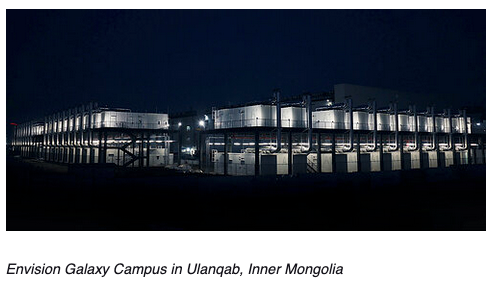
In keeping with this week's data center theme, we bring you a story from Inner Mongolia, where Chinese clean energy giant Envision—best known for its wind turbines, battery storage systems, and renewable energy projects—has entered the data center business at a massive scale.
This week Envision commissioned the first phase of its Galaxy Campus, an AI computing hub that it plans to expand to more than 2 GW of capacity. At full buildout, the campus is designed to support up to one million AI chips, making it one of the world's largest AI computing campuses. The facility will be a whopping 120,000 square meters—about 1.3 million square feet, or roughly 30 acres—of computing space under one roof.
|
|
|
 |
|
|
|
Rather than treating electricity as just another input, Envision is designing the computing infrastructure around the power system from day one. The campus will draw roughly 80% of its electricity directly from nearby wind farms via dedicated transmission lines, while battery storage will replace the diesel backup generators that have long been standard in the data center industry.
It's an intriguing inversion of the usual relationship between energy and AI, and one that we’re starting to see more and more of—and a natural extension for a company that already manufactures wind turbines, builds batteries, develops renewable projects, and manages grid infrastructure.
|
|
|
|
|
|
Thanks for diving into the Developer Dispatch with us.
|
|
|
|
|
|
|
|
|
|
Building American power requires a powerful team. |
|
|
|
|
|
|
|
|