|
|
 |
|
|
|
Good morning and happy Friday,
Energy news items that caught our attention this week span geopolitics, rural referenda, clean power economics, and even space-based solar.
U.S. fuel exports hit a record high last week, reaching 8.2 million barrels per day of refined petroleum products, up 1.5 million barrels compared to the same week last year. The administration “has rebuffed calls to restrict exports…as prices spike at home.”
Speaking of which, diesel prices are also surging, creating new inflation risks across the broader economy. Because diesel underpins freight, agriculture, construction, and industrial activity, higher prices are expected to ripple through everything from groceries to housing costs—adding political pressure ahead of the midterms.
In other news, voters in Ohio’s Richland County narrowly upheld a ban on utility-scale wind and solar development 53% to 47%—but “only about 1 in 4 primary voters...picked a Democratic ballot, meaning a broad swath of Republican voters wanted to reverse the ban.”
New analysis from RMI finds that wind and solar revenues in some rural states are beginning to approach the economic value of major crops like corn and soybeans, underscoring how clean energy is becoming an increasingly important rural income stream.
Globally, the economics continue shifting toward clean energy. A new IRENA report found that firm solar-plus-storage projects are now cost-competitive with new coal and gas generation at $54/MWh in high-quality / high-irradiance regions.
And in perhaps the week’s most futuristic headline, the U.S. Air Force awarded a contract to Overview Energy, a Virginia startup developing space-based solar power systems intended to reduce military dependence on vulnerable fuel supply chains in “logistically constrained environments.”
Read on for more.
|
|
|
 |
|
|
Radar Roadblock
For months, U.S. wind developers have been aware of a growing problem: the Trump administration has effectively stalled a large share of the onshore wind development pipeline by slowing or halting routine Pentagon reviews tied to radar and military operations. This week, the Financial Times reported on the true scale of the issue, which has expanded into a de facto nationwide freeze affecting more than 150—and possibly as many as 165—wind projects representing roughly 30 GW of capacity, including many located on private land and outside broader federal permitting processes. Here’s what’s happening:
-
The bottleneck involves the Department of Defense review process embedded in FAA airspace permitting. Prior to construction, wind developers typically obtain “no hazard” determinations confirming turbines will not interfere with military radar, flight paths, or training operations. Historically, projects distant from military facilities often cleared quickly, while more sensitive sites moved forward through negotiated mitigation agreements.
-
Radar interference itself is widely viewed as a manageable engineering issue rather than a fundamental obstacle to wind deployment. Historically, concerns were routinely resolved through established technical processes, and many projects received approvals within days or weeks—but currently, around 50 projects that “would probably have been declared risk-free in the past” are stalled.
-
Delays reportedly began emerging in summer 2025 and intensified this spring. Around 35 projects completed mitigation negotiations with the Pentagon but remain unsigned by Defense Department officials. According to ACP, reviews have stopped altogether, with meetings canceled and communications going unanswered, despite Secretary Burgum signaling that approvals would resume.
⚡️ The Takeaway
Department of delay. The administration appears to be extending tactics initially implemented in 2025 to impede five offshore projects due to unspecified national security concerns. In all five cases, federal courts found the administration’s arguments unpersuasive and allowed the projects to proceed. In terms of the onshore projects, ACP CEO Jason Grumet notes that the DOD has “just pulled the blinds on the offices that are obligated to do this work...it’s an abuse of a legitimate process that has now caused a major part of the energy economy to stall.”
|
|
|
 |
|
|
Clean Energy Tailwind
China’s 20+ year industrial strategy for wind power is now reshaping the global energy market—and recent geopolitical shocks are reinforcing the value of that approach. As conflict in Iran disrupts oil and gas markets, China’s vast domestic wind fleet, manufacturing scale, and transmission infrastructure are giving it greater energy security while many Western countries remain exposed to fossil fuel volatility. Here’s what to know:
-
Last year China installed three times more wind capacity than the rest of the world combined, and all six of the world’s largest turbine manufacturers are now Chinese. That dominance did not emerge organically. Beginning in 2005, Beijing used local-content requirements, subsidies, state-backed financing, and preferential procurement rules to build a domestic manufacturing base.
-
Foreign firms including Vestas, GE, and Gamesa localized production in China, but many ultimately trained the suppliers that have become their competitors.
-
Chinese manufacturers are now aggressively expanding abroad, with turbine and component exports surging into Europe, India, and Belt and Road markets. That growth is triggering anti-subsidy investigations, tariff threats, and national security scrutiny in Western markets.
-
China also paired manufacturing policy with long-term infrastructure planning. Massive onshore wind bases in western deserts are connected to coastal demand centers through ultrahigh-voltage transmission lines, while offshore wind deployment is rapidly expanding into deeper waters. Wind now supplies roughly 10% of China’s electricity, with market share increasing steadily each year as coal’s share declines.
⚡️ The Takeaway
A strategically planned windfall. The contrast between China and the U.S. and parts of Europe is increasingly stark. While China treats renewable energy as a strategic national security and industrial priority, U.S. policy has become more fragmented and politically volatile. Europe, meanwhile, is balancing decarbonization goals against growing concerns over dependence on Chinese clean energy supply chains. China spent two decades aligning industrial policy, grid investment, manufacturing support, and energy security objectives around wind, solar, and batteries—an approach now yielding both domestic resilience and global market leverage.
|
|
|
 |
|
|
-
Ripping the Bandaid Off: ‘Might not be the worst time’: Clean energy sector braces for tax credits phase-out
-
Death Spiral? Spiraling energy costs may tighten Texas governor’s race
-
Super Charge Me: Iran war is supercharging the clean energy transition, UN climate chief says
-
Wind in Their Sales? SMRs v renewables: mini nuclear's costs judgement day is coming
-
Fervo Fever: A $6.5B geothermal company? Industry eyes tipping point. and Fervo’s very big $6.5 billion IPO target
-
Level 3 Alert: NERC issues Level 3 alert, mandates action to address data center load losses and NERC sounds the alarm that data centers risk overtaxing the grid and AI boom sparks rare warning of ‘significant risks’ to grid
-
Don’t Call Me Shirley: In Indiana, an anatomy of data center opposition
-
$25 Billion in 2025: The hidden environmental cost of America’s data center boom
-
An Earful: The loud fight over inaudible data center noise
-
New Record: Local opposition to data centers explodes in 2026
-
Shark (Tank) Bite: Kevin O'Leary's massive data center project in Utah gets the greenlight, locals are furious
-
Interesting FTE Comparison: Data center jobs aren't at servers — they're in energy
-
I Can’t Quit You: EDP Renewables to keep US as top investment market despite offshore wind exit
-
Big Strides: Offshore wind firm that took US payout hits a milestone in Europe
-
Reckless Spending? California investigates Trump administration's deal to end Golden State Wind offshore wind project and California subpoenas Golden State Wind over lease deal
-
Dueling Claims: GE Vernova challenges Vineyard Wind's claims of harm if it leaves project
-
12 GW: California’s battery array is as powerful as 12 nuclear power plants. Here’s what’s on the horizon.
-
Motherlode: Untapped lithium on East Coast could replace US imports, USGS finds
-
Dang: Texas PV module production to exceed 15 GW in 2026
-
Circular Economy: New Texas solar panel recycling facility could process up to 600,000 solar panels per year
-
Power’s Out: Texas leads nation in utility shutoffs as electric bills rise, federal report finds
-
Making a Comeback: Gas power leapfrogs wind for first time in 10 years in ERCOT queue
-
“Prudent:” Ohio Supreme Court sides with AEP, denying $75 million in refunds for scandal-ridden coal plants costs
-
Under Review: AEP eyes exit from PJM, SPP over slow generation interconnection and AEP pivots to gas in $78bn buildout
-
High Stakes: Non-compliance with a looming NERC deadline could cost clean energy owners and operators, big time
-
Grid Optimization: White House is sitting on an executive order pushing advanced transmission
-
Relicensing Looms: Hydropower is in hot water. Will DOE release funding to help? and DOE to release $430M for American hydropower fleet
-
Permitting Power Couple: Unlikely Senate duo propels bipartisan dealmaking
-
A Conflict Ignited: The administration is trying to stop state climate lawsuits. It isn’t working.
-
Opinion: Making the most of the grid we already have
-
Report: U.S. inverter market faces policy, supply headwinds despite safe harbor pipeline
-
Podcast: Why John Arnold is ‘very optimistic’ permitting reform will pass this year
-
Podcast: Are Trump’s efforts against clean energy in vain?
-
Long Read: The outlaws who keep the power grid running
|
|
|
 |
|
|
|
|
 |
|
|
Mooving the Needle
This week’s Last Byte features a double-header on one of our favorite topics: agrivoltaics. Two solar projects—one focused on pollinators, the other on cattle grazing—offer developers novel ways to incorporate biodiversity land stewardship as core parts of project design.
Renewable energy investor Skyview Ventures is rolling out a biodiversity monitoring program across eight solar projects in New York, West Virginia, Tennessee, and Connecticut through a partnership with HiveTracks.
The company is integrating beekeeping, pollinator habitat management, and ecosystem monitoring directly into solar operations, collecting data on plant diversity, soil health, and pollinator activity from pre-construction through long-term operations.
The interesting shift here is the emphasis on measurable environmental outcomes: using operational data to guide vegetation management, improve drought resilience, reduce erosion risk, and strengthen habitat quality over time.
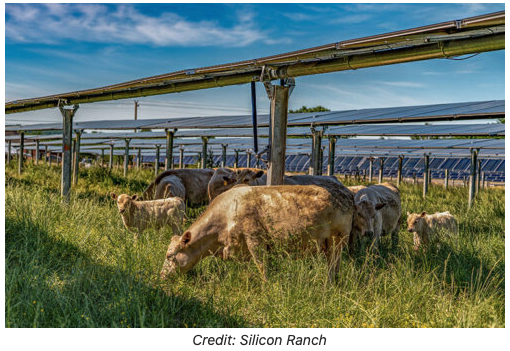
Meanwhile, Silicon Ranch officially launched its first commercial-scale “CattleTracker” solar project in Tennessee, debuting a patented solar tracker system designed specifically to accommodate cattle grazing beneath moving panels.
|
|
|
 |
|
|
|
While sheep grazing has become relatively common in solar, cattle-compatible infrastructure has remained largely experimental because of equipment durability and animal safety concerns. The Christiana Solar Ranch represents one of the first attempts to commercialize regenerative cattle grazing alongside utility-scale solar generation, backed by several years of field research and two newly awarded patents.
Together, the projects highlight how agrivoltaics is evolving beyond simple dual land use into a broader strategy for integrating clean energy development with agriculture, ecosystem restoration, and long-term land management.
|
|
|
|
|
|
Thanks for diving into the Developer Dispatch with us.
|
|
|
|
|
|
|
|
|
|
Building American power requires a powerful team. |
|
|
|
|
|
|
|
|


