|
|
 |
|
|
|
Good morning and happy Friday,
It was another choppy week in the financial markets and oil briefly hit $119 on Thursday. The country has also seen wild weather as blizzards, heat waves, tornadoes and floods all hit the U.S.
On Tuesday, President Trump welcomed the prime minister of Ireland to the White House for Saint Patrick’s Day. During their meeting the president said he wants ‘no windmills built in the United States,’ and indeed it was reported this week that administration officials are “drafting settlement agreements that would pay nearly $1 billion” to stop planned offshore wind farms.
Be that as it may, last Friday the U.S. offshore wind industry hit two milestones: in Rhode Island, Revolution Wind became the third project to achieve commercial operation, and in Massachusetts, Vineyard Wind 1 finished construction.
And, the latest report from Clean Investment Monitor finds that the clean energy sector hit record levels of investment in 2025, reaching $1.96 trillion—”a tripling of investment from only seven years ago.” However, over the past two years investment has slowed, “rising only 7% in 2025 after a 28% jump in 2023.”
All that investment is paying off—GlobalData projects that worldwide renewable capacity will more than double to 8.4 TW by 2031, with solar PV reaching nearly 6 TW by 2031—growing at a 13% compound annual rate from 2025 levels of 4.1 TW.
Read on for more.
|
|
|
 |
|
|
Desert Dynamo
New Mexico is showing that even as federal support wanes, states can emerge as clean energy hotspots. When DOE grants were canceled—including a $15 million award for rural microgrids—state programs stepped in to buffer projects against federal uncertainty. With aggressive renewable mandates and a growing pipeline of solar, wind, and battery storage projects, The Land of Enchantment is proving that clean energy can thrive when state-level incentives and market demand align. Here are some key points:
-
New Mexico’s 2045 clean energy mandate and state tax credits are driving rapid deployment, enabling utilities to replace retiring coal plants with solar-plus-storage systems and expand wind capacity faster than federal policy alone allows.
-
State-backed manufacturing incentives and local economic development programs are attracting major players, but navigating tariffs, foreign ownership rules, and loan guarantees adds a layer of strategic complexity for developers.
-
Advanced Energy Equipment Tax Credits are fueling opportunities in domestic production of solar panels, wind components, and battery systems, helping developers vertically integrate supply chains and reduce reliance on overseas suppliers.
-
Innovative battery technologies like sodium-nickel-chloride are emerging as safer, cost-effective alternatives to lithium-ion, with projects such as Desert Mountain Energy’s Roswell factory demonstrating that commercially viable energy storage can be built without heavy subsidies.
⚡️ The Takeaway
A clean leap. Overall, New Mexico shows how state policy, aggressive mandates, and local incentives can create a resilient clean energy ecosystem even when federal support is inconsistent. Developers who move quickly, align with state programs, and leverage emerging technologies will find a dynamic, opportunity-rich market. The state’s combination of regulatory certainty, growing renewable demand, and manufacturing initiatives makes it a model for how energy transition success can be engineered from the ground up.
|
|
|
 |
|
|
Solar Standoff
Alabama is at a crossroads over solar development as state legislators consider banning utility-scale projects. The controversy stems from a conflict in the tiny town of Stockton, where residents oppose a large solar farm intended to power a data center in Montgomery. The dispute has escalated into a statewide debate about local control, renewable energy, and how far the state should go in regulating or halting solar development.
-
Stockton residents, concerned about environmental and aesthetic impacts, have little authority over unzoned land where the solar project is planned. This gap prompted lawmakers to act at the state level.
-
Introduced by the senator representing Stockton, SB 354 would halt new utility-scale solar projects across most of Alabama for at least a year, with the Tennessee Valley Authority as a notable exception. The measure mirrors a 2013 temporary statewide restriction on wind farms in response to local disputes.
-
While Governor Kay Ivey previously supported the associated data center, the bill has advanced through the state senate’s energy committee. Its final passage remains uncertain amid lobbying from pro-renewables groups seeking either to block the ban or narrow it to Stockton and Baldwin County.
-
If enacted, SB 354 could delay new solar projects statewide, create regulatory uncertainty for investors, and signal that local objections can trigger broader moratoria on renewable energy.
⚡️ The Takeaway
Blocking the sun. The controversy in Stockton highlights the tension between local interests, long-term energy needs, and economic goals. How Alabama resolves it could shape not only the state’s solar future but also broader debates about balancing demand for both computing power and clean, affordable energy. Similar pressures are emerging elsewhere: in Missouri, lawmakers are considering a sweeping statewide moratorium that would halt solar projects that are under developed or under construction through at least 2027, underscoring how local conflicts are increasingly driving state energy policy.
|
|
|
 |
|
|
-
Dialing Up the Rhetoric: Democrats hammer president on ‘energy affordability’
-
Back to the Future: House Democrats want clean energy tax credits back and House Democrats unveil energy policy priorities as Senate talks resume
-
Moribund: Interior bends on solar, but wind energy on public lands remains stalled
-
Stay the Course: Dem permitting negotiators wave off attacks on offshore wind
-
Opinion: Terms of surrender in the war on wind
-
Repeal Challenged: 24 states sue over Trump’s climate rollback
-
Capital Confidence: Next-gen geothermal company Fervo Energy has crossed the bankability divide
-
Feeling the Pinch: How solar is getting squeezed in the Iran war
-
Cushioned: China’s clean energy push has made it less vulnerable to energy shocks, including the Iran war
-
“Twisted:” 13 DOE emergency orders have cost Americans $235M, Sierra Club says
-
Lotsa Questions: Senate Democrats probe gas-powered AI data centers
-
Disrupted by Data: Data centers are already dominating this year’s elections and Data centers complicate the Salt River Project election
-
Whoa: Data center demand spike could drive 79% ERCOT price hike in 2027: EIA
-
Details: Big Tech pledged to pay for power — but 25 tariffs in 19 states already require it
-
“Clean Transition Tariff:” Duke Energy agrees to explore a cleaner way to power data centers
-
Waste Not, Want Not: Wastewater will cool this Memphis data center
-
Stalling Out: U.S. data center pipeline growth slows as grid constraints mount and Inside the massive private power grids fueling the U.S. data center boom
-
Certainty and Stability: Mass. governor orders state to pursue 15 GW of resources, including storage, VPPs and New Jersey announces 355-MW storage procurement, solicits 645 MW more
-
A STEP Forward: UK to convert former coal station into the nation's first fusion power plant
-
Playing the Field: DOE courts Westinghouse rivals amid slow talks on new nuclear
-
Playbook: How to lobby this administration on energy
-
Legal Alert: Treasury domestic content guidance on blue wafers creates compliance risks for solar developers
-
ESA Exemption? ‘God Squad’ looks to ease ESA rules in Gulf of Mexico and Greens sue Interior to stop 3/31 ‘God Squad’ meeting
-
“Echoes of Feudalism:” In Arizona, an electric utility holds an election, open only to property owners
-
“The Largest Project You’ll Never See:” Hydropower line from Quebec to Queens could power a million N.Y.C. homes
-
Groundbreaking: FERC approves SPP merger of interconnection, transmission planning
-
NERC: AI power demand creates ‘high likelihood, high impact’ grid risks
-
From GRIP to SPARK: DOE rolls out $1.9B funding opportunity for 'urgently needed' grid upgrades
-
Pump It Up: Could pumped storage hydropower serve as a reliable data center power source?
-
Pop Quiz: Which states have the most grid batteries?
- We ♥️ Wind: How a tiny Texas town is using wind energy to help out senior citizens
|
|
|
 |
|
|
|
|
 |
|
|
Sea Change: AI’s New Offshore Frontier
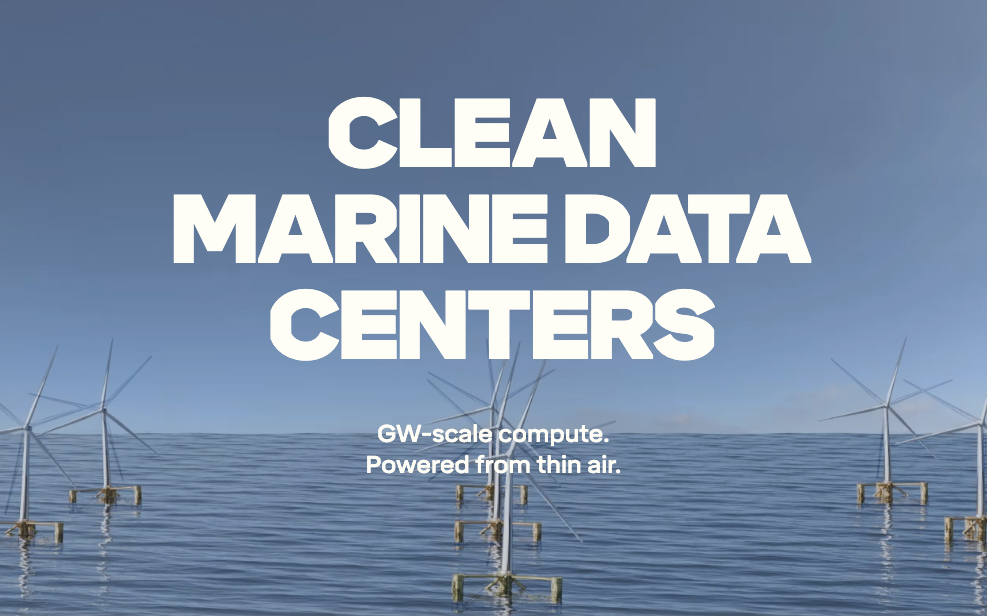
The Japanese martial art aikido translates to “the way of harmonizing energy”—a fitting name for a U.S. startup aiming to do exactly that, by pairing AI data centers with floating wind turbines.
Aikido Technologies’ new platform, AO60DC, is designed to let AI workloads run directly on clean energy generated at sea. Instead of building land-based data centers that consume vast amounts of electricity and water, the company proposes moving compute offshore—where turbines generate power and the surrounding ocean doubles as a natural cooling system.
The appeal is both practical and environmental. AI data centers are notoriously power- and water-hungry, but Aikido’s design sidesteps freshwater use by treating seawater as an almost limitless heat sink, easing pressure on local resources. Co-locating power generation and computing also reduces transmission losses and trims infrastructure costs.
|
|
|
 |
|
|
|
Built with scalability in mind, the platform can support installations ranging from 30 MW to 1 GW. Each unit delivers 10–12 MW of compute, powered by a 15–18 MW turbine. Its modular “flat-pack” floating structure promises quicker assembly and lower capital costs, while integrated batteries help smooth out energy supply.
Efficiency is another selling point, with a projected power usage effectiveness (PUE) of 1.08 thanks to passive cooling. The system can also tap into existing offshore maintenance networks. Still early in development, the concept is being tested in Norway, with a first commercial deployment targeted in the UK by 2028. If it works, the future of AI might not live on land at all—but out at sea, powered by wind and cooled by the ocean itself.
|
|
|
|
|
|
Thanks for diving into the Developer Dispatch with us.
|
|
|
|
|
|
|
|
|
|
Building American power requires a powerful team. |
|
|
|
|
|
|
|
|


